
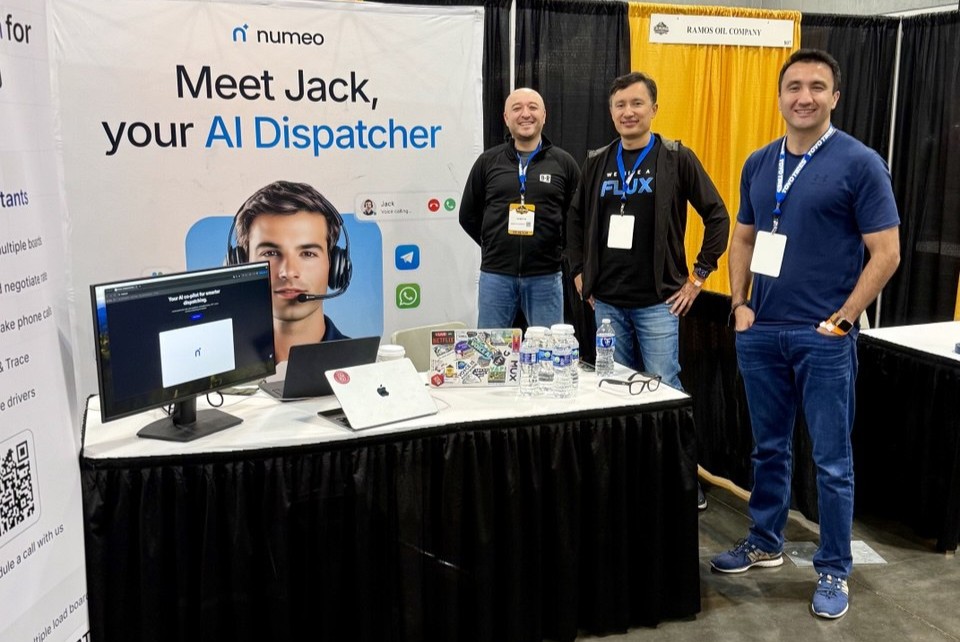





Despite his extensive experience, this new startup represents largely uncharted territory for the Uzbek founder. First, the company is registered in the United States and is focused exclusively on the U.S. market—previously, Akmal had worked only in his home country. Second, it operates in a different industry: the startup works directly with freight carriers rather than other participants in the logistics ecosystem. Third, the solution is built on artificial intelligence—a rapidly growing field—and the project has already raised several million dollars in investment from the venture capital fund NFX.
As part of the joint project by Digital Business and Astana Hub, “100 Startup Stories of Central Asia,” Akmal spoke about the development of Numeo AI, the specifics of the U.S. logistics market—where the freight transportation sector is already valued at $850 billion—as well as skepticism toward AI among industry workers and plans to scale the startup across the American market.
“In the U.S., There Are Many Freight Companies Founded by People from Uzbekistan or Other Central Asian Countries”
— What were you doing previously? How did you enter the IT industry?
— I’ve been building startups for about 20 years now. In total, there have been four major projects, and two of them resulted in exits. Numeo AI is our fifth company.
Previously, we created a telemetry platform at the startup MaxTrack, a food delivery company called Express24 (which was later sold to Yandex), and the MyTaxi aggregator, which became the leader in corporate transportation in Uzbekistan. We also launched Workly, a service for automating HR processes in companies. By the way, not long ago we announced a consolidation of assets with the Kazakh startup Clockster, which has now taken over the product and team of Workly to develop everything under a single brand.
— Food delivery, passenger transportation, telemetry—all of this intersects with logistics. Numeo AI looks like a natural evolution of what you’ve done before. Still, how did you arrive at this new project?
— Last year, I moved to the United States and started thinking about ideas for a new company. The initial idea was completely different, and we even spent some time working on it.
At first, we wanted to focus on service optimization in the restaurant business. The startup was called SpeechSense. The idea was to create a kind of digital supervisor. In my previous company, I worked with restaurants for about seven years and understood their pain points very well. For example, management efficiency was often far from ideal, as was staff interaction with customers. It became clear that artificial intelligence could be very useful here.
We wanted to build digital “microphones” that would listen to and analyze how restaurant staff—waiters, hosts—communicate with guests. AI could recognize context, understand complaints, analyze the customer’s tone of voice, identify issues that arose, and see how employees resolved them. The agent would then provide recommendations on how to improve overall business operations and service quality.
But a major problem emerged. If you want to build a large company, you need to sell to big chains. And there was a serious obstacle: popular franchises are afraid of scandals and negative publicity. Any news suggesting they are “listening in” on customers could seriously damage their reputation. A headline like “Starbucks Listens to Your Conversations” would be a huge problem for a franchise, even if the AI agent operated fully within U.S. law.
This became a major blocker for us. From a legal standpoint, all issues could be resolved. But if companies are unwilling to adopt a solution due to image and reputational risks, it’s extremely difficult to change their minds. We realized this while already in discussions with several large restaurant chains.
So we put that idea on hold and started thinking about where else we could apply our existing AI technologies. One of those areas was logistics. Everything is different there—and, importantly, we’re not eavesdropping. The AI agent communicates directly with market participants: carriers, brokers, and logistics managers.
Inefficiencies in Logistics and the Role of AI
— You mentioned inefficiencies in logistics. What do they look like, and how does an AI agent help improve the situation?
— Everything revolves around people—and people are imperfect. Sometimes we make emotionally driven decisions that aren’t optimal. Or we act with limited data, without seeing the full picture, relying partly on assumptions or intuition.
Let’s imagine a truck driver is available and can take a load in Chicago. If you open a spreadsheet with available freight, you’ll see thousands of different loads. How can you analyze that volume of information in 20–30 minutes and determine which option is the most attractive and valuable for you? Especially when new offers appear every second. This is exactly where algorithms perform far better than humans.
Read more at Digitalbusiness.kz.
Despite his extensive experience, this new startup represents largely uncharted territory for the Uzbek founder. First, the company is registered in the United States and is focused exclusively on the U.S. market—previously, Akmal had worked only in his home country. Second, it operates in a different industry: the startup works directly with freight carriers rather than other participants in the logistics ecosystem. Third, the solution is built on artificial intelligence—a rapidly growing field—and the project has already raised several million dollars in investment from the venture capital fund NFX.
As part of the joint project by Digital Business and Astana Hub, “100 Startup Stories of Central Asia,” Akmal spoke about the development of Numeo AI, the specifics of the U.S. logistics market—where the freight transportation sector is already valued at $850 billion—as well as skepticism toward AI among industry workers and plans to scale the startup across the American market.
“In the U.S., There Are Many Freight Companies Founded by People from Uzbekistan or Other Central Asian Countries”
— What were you doing previously? How did you enter the IT industry?
— I’ve been building startups for about 20 years now. In total, there have been four major projects, and two of them resulted in exits. Numeo AI is our fifth company.
Previously, we created a telemetry platform at the startup MaxTrack, a food delivery company called Express24 (which was later sold to Yandex), and the MyTaxi aggregator, which became the leader in corporate transportation in Uzbekistan. We also launched Workly, a service for automating HR processes in companies. By the way, not long ago we announced a consolidation of assets with the Kazakh startup Clockster, which has now taken over the product and team of Workly to develop everything under a single brand.
— Food delivery, passenger transportation, telemetry—all of this intersects with logistics. Numeo AI looks like a natural evolution of what you’ve done before. Still, how did you arrive at this new project?
— Last year, I moved to the United States and started thinking about ideas for a new company. The initial idea was completely different, and we even spent some time working on it.
At first, we wanted to focus on service optimization in the restaurant business. The startup was called SpeechSense. The idea was to create a kind of digital supervisor. In my previous company, I worked with restaurants for about seven years and understood their pain points very well. For example, management efficiency was often far from ideal, as was staff interaction with customers. It became clear that artificial intelligence could be very useful here.
We wanted to build digital “microphones” that would listen to and analyze how restaurant staff—waiters, hosts—communicate with guests. AI could recognize context, understand complaints, analyze the customer’s tone of voice, identify issues that arose, and see how employees resolved them. The agent would then provide recommendations on how to improve overall business operations and service quality.
But a major problem emerged. If you want to build a large company, you need to sell to big chains. And there was a serious obstacle: popular franchises are afraid of scandals and negative publicity. Any news suggesting they are “listening in” on customers could seriously damage their reputation. A headline like “Starbucks Listens to Your Conversations” would be a huge problem for a franchise, even if the AI agent operated fully within U.S. law.
This became a major blocker for us. From a legal standpoint, all issues could be resolved. But if companies are unwilling to adopt a solution due to image and reputational risks, it’s extremely difficult to change their minds. We realized this while already in discussions with several large restaurant chains.
So we put that idea on hold and started thinking about where else we could apply our existing AI technologies. One of those areas was logistics. Everything is different there—and, importantly, we’re not eavesdropping. The AI agent communicates directly with market participants: carriers, brokers, and logistics managers.
Inefficiencies in Logistics and the Role of AI
— You mentioned inefficiencies in logistics. What do they look like, and how does an AI agent help improve the situation?
— Everything revolves around people—and people are imperfect. Sometimes we make emotionally driven decisions that aren’t optimal. Or we act with limited data, without seeing the full picture, relying partly on assumptions or intuition.
Let’s imagine a truck driver is available and can take a load in Chicago. If you open a spreadsheet with available freight, you’ll see thousands of different loads. How can you analyze that volume of information in 20–30 minutes and determine which option is the most attractive and valuable for you? Especially when new offers appear every second. This is exactly where algorithms perform far better than humans.
Read more at Digitalbusiness.kz.

 Share
Share