
The post has been translated automatically. Original language: English




By early 2026, over 10,000 MCP servers exist. Most marketing analysts haven't heard of them yet.
What is an MCP server?
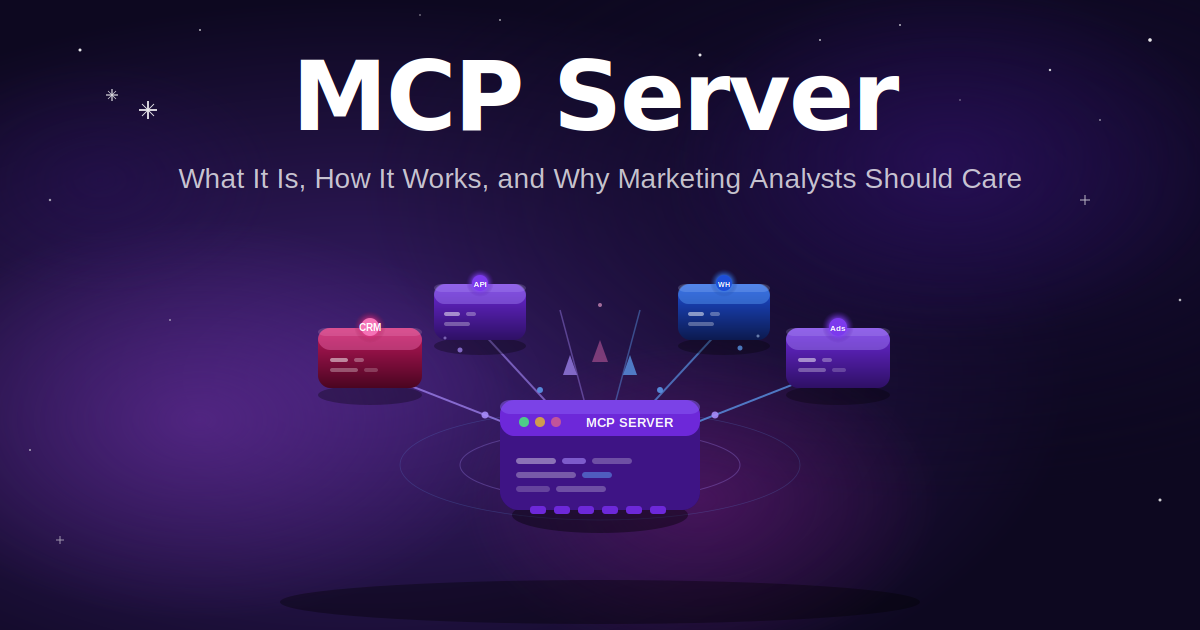
MCP servers act as a middleware layer connecting AI agents to data sources — giving large language models secure, structured access to databases, APIs, and internal tools.
The practical upside: without an MCP server, your AI agent can't read campaign data, access your CRM, or pull metrics from ad platforms. With one, it can answer "Which campaigns drove the most pipeline last quarter?" in seconds.
How it works
Anthropic launched the Model Context Protocol in November 2024 to standardize how AI systems access external data. Before MCP, every integration meant writing custom code from scratch. Now, an analyst asks Claude a question, the AI sends a structured request to the MCP server, which authenticates with the relevant API, fetches the data, and returns it in a format the agent can understand.
Why marketing teams should care
Marketing analysts spend hours answering the same questions every week — how much was spent on Meta, which landing pages convert best, what's the CAC by channel. MCP servers shift that workflow from dashboards and SQL queries to plain conversation with an AI. Budget monitoring, attribution analysis, anomaly detection, spend forecasting — all through a simple question in chat.
One important caveat
MCP servers are connectors, not data platforms. They don't fix data quality issues, normalize schemas, or transform raw API responses into usable metrics. Clean data in, clean answers out.
For the full breakdown — architecture, security, implementation patterns, and what to look for in an MCP-ready marketing platform — read the original article:
👉 MCP Server: What It Is, How It Works, and Why Marketing Analysts Should Care in 2026
By early 2026, over 10,000 MCP servers exist. Most marketing analysts haven't heard of them yet.
What is an MCP server?
MCP servers act as a middleware layer connecting AI agents to data sources — giving large language models secure, structured access to databases, APIs, and internal tools.
The practical upside: without an MCP server, your AI agent can't read campaign data, access your CRM, or pull metrics from ad platforms. With one, it can answer "Which campaigns drove the most pipeline last quarter?" in seconds.
How it works
Anthropic launched the Model Context Protocol in November 2024 to standardize how AI systems access external data. Before MCP, every integration meant writing custom code from scratch. Now, an analyst asks Claude a question, the AI sends a structured request to the MCP server, which authenticates with the relevant API, fetches the data, and returns it in a format the agent can understand.
Why marketing teams should care
Marketing analysts spend hours answering the same questions every week — how much was spent on Meta, which landing pages convert best, what's the CAC by channel. MCP servers shift that workflow from dashboards and SQL queries to plain conversation with an AI. Budget monitoring, attribution analysis, anomaly detection, spend forecasting — all through a simple question in chat.
One important caveat
MCP servers are connectors, not data platforms. They don't fix data quality issues, normalize schemas, or transform raw API responses into usable metrics. Clean data in, clean answers out.
For the full breakdown — architecture, security, implementation patterns, and what to look for in an MCP-ready marketing platform — read the original article:
👉 MCP Server: What It Is, How It Works, and Why Marketing Analysts Should Care in 2026
 Share
Share