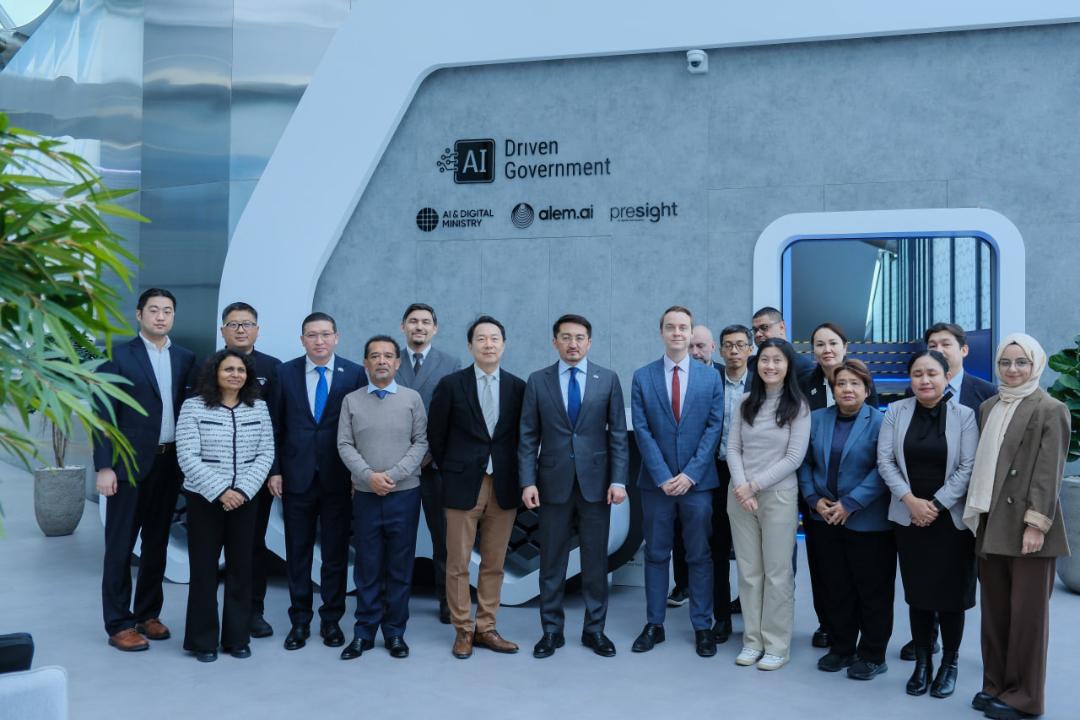





The guests were introduced to the center’s infrastructure and Kazakhstan’s AI solutions.
The visit took place within the framework of the UN ESCAP Special Working Group on the establishment of a Digital Solutions Center and continued discussions initiated in September 2024 at the Asia-Pacific Ministerial Conference on Digital Inclusion and Transformation. At that time, an initiative was proposed to establish a UN ESCAP Regional Digital Solutions Center in Almaty.
Such international initiatives align with the course set by the Head of State. This year for the country is about concrete steps in digital development: we are consistently implementing technologies, developing infrastructure, and expanding the use of artificial intelligence in the economy and public administration.
Deputy Prime Minister — Minister of Artificial Intelligence and Digital Development of the Republic of Kazakhstan, Zhaslan Madiyev, presented the concept of the Exponential Cluster and a comprehensive approach to industry development to the participants.

During the visit, the delegation was presented with the key spaces of alem.ai. The introduction to artificial intelligence began at the Museum of Singularity, which reflects the evolution of AI — from philosophical ideas of the 17th century to modern neural network and generative models. The exhibition includes interactive zones demonstrating the capabilities of modern technologies.
The practical application of AI is showcased in the Smart City zone as a tool for managing urban infrastructure, including solutions in smart mobility, energy systems, and public safety. In the AI Cinema immersive theater with 180° projection, the delegation explored content created on the platform of Kazakhstan’s first tech unicorn, Higgsfield AI.
A separate section was dedicated to GovTech solutions, space industry projects, and developments by the USTEM Foundation. AI-powered humanoid robots and robotic systems demonstrated the execution of various tasks in real time.
Special attention was given to startups — participants of Astana Hub — focused on international markets. Among the showcased initiatives were Weglobal AI, an AI-based platform for optimizing the work of school psychologists and career counselors; NCSpeech, a decentralized AI infrastructure for building high-quality datasets for artificial intelligence training; AMAN, a service for rapid alerting and response to threats to child safety; Armeta AI, an intelligent platform for automating expert review and approval of construction projects; and WONK, a unified AI-powered school management platform with analytics and process automation tools.
The visit confirmed the strong interest of international partners in the development of digital solutions in Kazakhstan and highlighted the country’s potential as a regional hub for cooperation in artificial intelligence.


The guests were introduced to the center’s infrastructure and Kazakhstan’s AI solutions.
The visit took place within the framework of the UN ESCAP Special Working Group on the establishment of a Digital Solutions Center and continued discussions initiated in September 2024 at the Asia-Pacific Ministerial Conference on Digital Inclusion and Transformation. At that time, an initiative was proposed to establish a UN ESCAP Regional Digital Solutions Center in Almaty.
Such international initiatives align with the course set by the Head of State. This year for the country is about concrete steps in digital development: we are consistently implementing technologies, developing infrastructure, and expanding the use of artificial intelligence in the economy and public administration.
Deputy Prime Minister — Minister of Artificial Intelligence and Digital Development of the Republic of Kazakhstan, Zhaslan Madiyev, presented the concept of the Exponential Cluster and a comprehensive approach to industry development to the participants.
During the visit, the delegation was presented with the key spaces of alem.ai. The introduction to artificial intelligence began at the Museum of Singularity, which reflects the evolution of AI — from philosophical ideas of the 17th century to modern neural network and generative models. The exhibition includes interactive zones demonstrating the capabilities of modern technologies.
The practical application of AI is showcased in the Smart City zone as a tool for managing urban infrastructure, including solutions in smart mobility, energy systems, and public safety. In the AI Cinema immersive theater with 180° projection, the delegation explored content created on the platform of Kazakhstan’s first tech unicorn, Higgsfield AI.
A separate section was dedicated to GovTech solutions, space industry projects, and developments by the USTEM Foundation. AI-powered humanoid robots and robotic systems demonstrated the execution of various tasks in real time.
Special attention was given to startups — participants of Astana Hub — focused on international markets. Among the showcased initiatives were Weglobal AI, an AI-based platform for optimizing the work of school psychologists and career counselors; NCSpeech, a decentralized AI infrastructure for building high-quality datasets for artificial intelligence training; AMAN, a service for rapid alerting and response to threats to child safety; Armeta AI, an intelligent platform for automating expert review and approval of construction projects; and WONK, a unified AI-powered school management platform with analytics and process automation tools.
The visit confirmed the strong interest of international partners in the development of digital solutions in Kazakhstan and highlighted the country’s potential as a regional hub for cooperation in artificial intelligence.

 Share
Share