




What connects them is a single question: how technology is reshaping where companies, capital, knowledge, and new centers of global influence emerge.
On October 2–3, Astana will once again host the international technology forum AI & Digital Bridge 2026. This year’s central theme—“Kazakhstan is the Eurasian AI Hub”—focuses on Kazakhstan’s role as a hub connecting technology markets, talent, capital, and emerging AI companies.
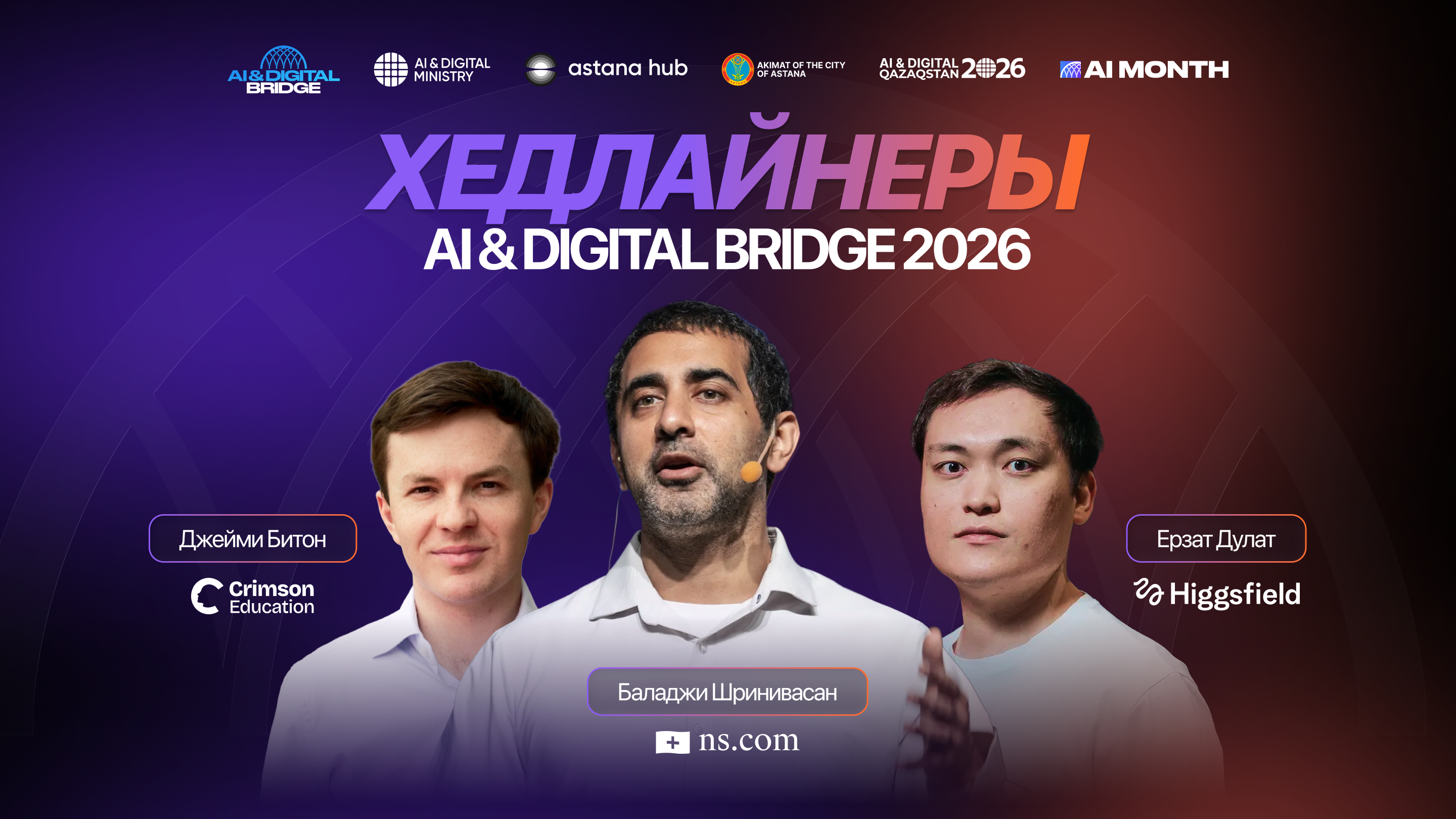
Among the forum’s headliners are entrepreneur and investor Balaji Srinivasan, Co-Founder and CTO of Higgsfield AI Yerzat Dulat, and Founder of Crimson Education Jamie Beaton.
Their career paths span three distinct areas—from Silicon Valley and venture capital to generative AI and global education. Together, they reflect three key resources that technology-driven economies are competing for today: ideas, talent, and the ability to build companies on a global scale.
Balaji Srinivasan: What Comes After the Traditional Geography of Silicon Valley
Balaji Srinivasan is one of the most prominent figures in the American technology and venture capital ecosystem. An entrepreneur and investor, former CTO of Coinbase and General Partner at Andreessen Horowitz (a16z), he now runs The Network School and continues to develop the concept of The Network State.
At the core of this concept is the idea that technology changes not only individual industries, but the very way communities are formed. People united by shared values and economic interests can build digital communities first, and then extend their infrastructure into the physical world.
Srinivasan detailed this model in his book The Network State. Today, however, it is no longer just a theory for him: The Network School is developing as a physical environment for entrepreneurs, engineers, and technology company founders.
For Kazakhstan, this context is especially relevant. In 2026, collaboration with The Network School entered a practical phase, with discussions underway on developing educational and entrepreneurial infrastructure capable of connecting Kazakhstan with the international community of engineers, founders, and investors.
That is why the conversation with Srinivasan at AI & Digital Bridge goes far beyond another discussion of artificial intelligence trends. At its core is a more fundamental question: can the next world-class tech ecosystem emerge outside traditional centers like Silicon Valley—and what will it take to make that happen?
Yerzat Dulat: A Global AI Company with a Kazakhstani Co-Founder
While Srinivasan speaks about the formation of new technology hubs, Yerzat Dulat’s story shows how the geography of building global companies is changing.
Kazakhstani engineer Yerzat Dulat is the Co-Founder and CTO of Higgsfield AI, a generative artificial intelligence platform for creating videos and images.
Over the past year, Higgsfield has become one of the fastest-growing players in the generative media market. In August 2026, the company raised $400 million in a Series B round at a $5.4 billion valuation. According to the company, at the time of the funding round, more than 30 million people were using its platform, while its corporate customer base included hundreds of Fortune 500 companies.
Behind these investment numbers lies a far broader shift. Generative AI is moving beyond experimental tools to become a core part of the production infrastructure in marketing, advertising, film, design, and the media industry.
This is precisely why Dulat’s story holds special significance for Kazakhstan.
Not long ago, the typical career path for a talented engineer from the region often involved relocating to work within an established global technology company. Today, a different scenario is taking shape: a specialist from Kazakhstan can become a co-founder of a company that shapes the global technology market.
For developers, this is a story about the scale of professional ambition. For entrepreneurs, it is about building a product for international markets from day one. For investors, it is evidence that a tech company’s origin and its global potential are becoming increasingly decoupled from geography.
Jamie Beaton: Human Capital as Technology Infrastructure
The forum’s third headliner represents another arena of global competition—education and talent.
Jamie Beaton is the Co-Founder and CEO of Crimson Education, an international education company that helps students gain admission to the world’s leading universities and develops its own educational products, including the online school Crimson Global Academy.
Beaton is both an entrepreneur and an example of an unconventional educational path. He studied at Harvard, Stanford, Oxford, Yale, Princeton, the University of Pennsylvania, Tsinghua, and other universities, and was a Rhodes Scholar at Oxford.
However, for AI & Digital Bridge, what matters most is not the number of degrees he holds, but the business built around global competition for education.
Crimson Education has grown from an educational startup into an international company with a network of students, educators, and mentors across dozens of countries. A separate area of focus is Crimson Global Academy—an accredited online school serving students around the world.
Against the backdrop of AI development, the question of education becomes even more pressing. As technology automates an increasing share of intellectual tasks, our understanding of what people need to learn, which skills retain their value, and how to prepare a new generation for jobs that do not yet exist is shifting.
For Kazakhstan, this is directly tied to its ambition to become a regional AI hub. A technology ecosystem cannot be built on data centers, investment, or international companies alone. Its most critical scarce resource is people.
Three Paths, One Question: Where Will the Next Technology Economy Be Built?
At first glance, Srinivasan, Dulat, and Beaton work in entirely different fields.
Srinivasan explores how digital technologies are reshaping communities, entrepreneurship, and the very geography of innovation.
Dulat is directly at the heart of the global AI race, showing how an engineering team turns new artificial intelligence models into a product for tens of millions of users and the world’s largest companies.
Beaton focuses on another fundamental resource—education and human capital, without which a technological leap forward would not be possible.
It is precisely at the intersection of these three pillars—technology, entrepreneurship, and talent—that the new map of the global economy is being drawn today.
For Kazakhstan, the question is no longer merely how to adopt technologies developed elsewhere more rapidly. The next stage is creating the conditions that will allow global AI products, technology companies, research teams, and new educational models to emerge and scale from Kazakhstan.
AI & Digital Bridge 2026
AI & Digital Bridge 2026 will take place from October 1 to 3 at the EXPO International Exhibition Centre in Astana and will serve as the central international event of AI MONTH.
On October 1, a special high-level program will be held with the participation of senior government officials, international delegations, and technology industry leaders. Attendance at the events on this day is by special invitation only.
On October 2–3, the open program of AI & Digital Bridge 2026 will be available to ticket holders. Over these two days, representatives of global technology companies, international speakers, startups, and investors will come together at one venue.
The organization of AI & Digital Bridge 2026 was made possible through the support of the forum’s partners and sponsors. All forum expenses are covered by sponsorship funds.
Gold Partners: Freedom Bank Kazakhstan JSC, Kaspi.kz, Samruk-Kazyna JSC, and Kazakhtelecom JSC. Silver Partner: Halyk Bank. Business Partner: Beeline Kazakhstan. Bronze Partner: Yandex Qazaqstan. Official Airline Partner: Air Astana.
AI & Digital Bridge 2026 is organized by the Ministry of Artificial Intelligence and Digital Development of the Republic of Kazakhstan, Astana Hub, and the Akimat of Astana.
What connects them is a single question: how technology is reshaping where companies, capital, knowledge, and new centers of global influence emerge.
On October 2–3, Astana will once again host the international technology forum AI & Digital Bridge 2026. This year’s central theme—“Kazakhstan is the Eurasian AI Hub”—focuses on Kazakhstan’s role as a hub connecting technology markets, talent, capital, and emerging AI companies.
Among the forum’s headliners are entrepreneur and investor Balaji Srinivasan, Co-Founder and CTO of Higgsfield AI Yerzat Dulat, and Founder of Crimson Education Jamie Beaton.
Their career paths span three distinct areas—from Silicon Valley and venture capital to generative AI and global education. Together, they reflect three key resources that technology-driven economies are competing for today: ideas, talent, and the ability to build companies on a global scale.
Balaji Srinivasan: What Comes After the Traditional Geography of Silicon Valley
Balaji Srinivasan is one of the most prominent figures in the American technology and venture capital ecosystem. An entrepreneur and investor, former CTO of Coinbase and General Partner at Andreessen Horowitz (a16z), he now runs The Network School and continues to develop the concept of The Network State.
At the core of this concept is the idea that technology changes not only individual industries, but the very way communities are formed. People united by shared values and economic interests can build digital communities first, and then extend their infrastructure into the physical world.
Srinivasan detailed this model in his book The Network State. Today, however, it is no longer just a theory for him: The Network School is developing as a physical environment for entrepreneurs, engineers, and technology company founders.
For Kazakhstan, this context is especially relevant. In 2026, collaboration with The Network School entered a practical phase, with discussions underway on developing educational and entrepreneurial infrastructure capable of connecting Kazakhstan with the international community of engineers, founders, and investors.
That is why the conversation with Srinivasan at AI & Digital Bridge goes far beyond another discussion of artificial intelligence trends. At its core is a more fundamental question: can the next world-class tech ecosystem emerge outside traditional centers like Silicon Valley—and what will it take to make that happen?
Yerzat Dulat: A Global AI Company with a Kazakhstani Co-Founder
While Srinivasan speaks about the formation of new technology hubs, Yerzat Dulat’s story shows how the geography of building global companies is changing.
Kazakhstani engineer Yerzat Dulat is the Co-Founder and CTO of Higgsfield AI, a generative artificial intelligence platform for creating videos and images.
Over the past year, Higgsfield has become one of the fastest-growing players in the generative media market. In August 2026, the company raised $400 million in a Series B round at a $5.4 billion valuation. According to the company, at the time of the funding round, more than 30 million people were using its platform, while its corporate customer base included hundreds of Fortune 500 companies.
Behind these investment numbers lies a far broader shift. Generative AI is moving beyond experimental tools to become a core part of the production infrastructure in marketing, advertising, film, design, and the media industry.
This is precisely why Dulat’s story holds special significance for Kazakhstan.
Not long ago, the typical career path for a talented engineer from the region often involved relocating to work within an established global technology company. Today, a different scenario is taking shape: a specialist from Kazakhstan can become a co-founder of a company that shapes the global technology market.
For developers, this is a story about the scale of professional ambition. For entrepreneurs, it is about building a product for international markets from day one. For investors, it is evidence that a tech company’s origin and its global potential are becoming increasingly decoupled from geography.
Jamie Beaton: Human Capital as Technology Infrastructure
The forum’s third headliner represents another arena of global competition—education and talent.
Jamie Beaton is the Co-Founder and CEO of Crimson Education, an international education company that helps students gain admission to the world’s leading universities and develops its own educational products, including the online school Crimson Global Academy.
Beaton is both an entrepreneur and an example of an unconventional educational path. He studied at Harvard, Stanford, Oxford, Yale, Princeton, the University of Pennsylvania, Tsinghua, and other universities, and was a Rhodes Scholar at Oxford.
However, for AI & Digital Bridge, what matters most is not the number of degrees he holds, but the business built around global competition for education.
Crimson Education has grown from an educational startup into an international company with a network of students, educators, and mentors across dozens of countries. A separate area of focus is Crimson Global Academy—an accredited online school serving students around the world.
Against the backdrop of AI development, the question of education becomes even more pressing. As technology automates an increasing share of intellectual tasks, our understanding of what people need to learn, which skills retain their value, and how to prepare a new generation for jobs that do not yet exist is shifting.
For Kazakhstan, this is directly tied to its ambition to become a regional AI hub. A technology ecosystem cannot be built on data centers, investment, or international companies alone. Its most critical scarce resource is people.
Three Paths, One Question: Where Will the Next Technology Economy Be Built?
At first glance, Srinivasan, Dulat, and Beaton work in entirely different fields.
Srinivasan explores how digital technologies are reshaping communities, entrepreneurship, and the very geography of innovation.
Dulat is directly at the heart of the global AI race, showing how an engineering team turns new artificial intelligence models into a product for tens of millions of users and the world’s largest companies.
Beaton focuses on another fundamental resource—education and human capital, without which a technological leap forward would not be possible.
It is precisely at the intersection of these three pillars—technology, entrepreneurship, and talent—that the new map of the global economy is being drawn today.
For Kazakhstan, the question is no longer merely how to adopt technologies developed elsewhere more rapidly. The next stage is creating the conditions that will allow global AI products, technology companies, research teams, and new educational models to emerge and scale from Kazakhstan.
AI & Digital Bridge 2026
AI & Digital Bridge 2026 will take place from October 1 to 3 at the EXPO International Exhibition Centre in Astana and will serve as the central international event of AI MONTH.
On October 1, a special high-level program will be held with the participation of senior government officials, international delegations, and technology industry leaders. Attendance at the events on this day is by special invitation only.
On October 2–3, the open program of AI & Digital Bridge 2026 will be available to ticket holders. Over these two days, representatives of global technology companies, international speakers, startups, and investors will come together at one venue.
The organization of AI & Digital Bridge 2026 was made possible through the support of the forum’s partners and sponsors. All forum expenses are covered by sponsorship funds.
Gold Partners: Freedom Bank Kazakhstan JSC, Kaspi.kz, Samruk-Kazyna JSC, and Kazakhtelecom JSC. Silver Partner: Halyk Bank. Business Partner: Beeline Kazakhstan. Bronze Partner: Yandex Qazaqstan. Official Airline Partner: Air Astana.
AI & Digital Bridge 2026 is organized by the Ministry of Artificial Intelligence and Digital Development of the Republic of Kazakhstan, Astana Hub, and the Akimat of Astana.

 Share
Share