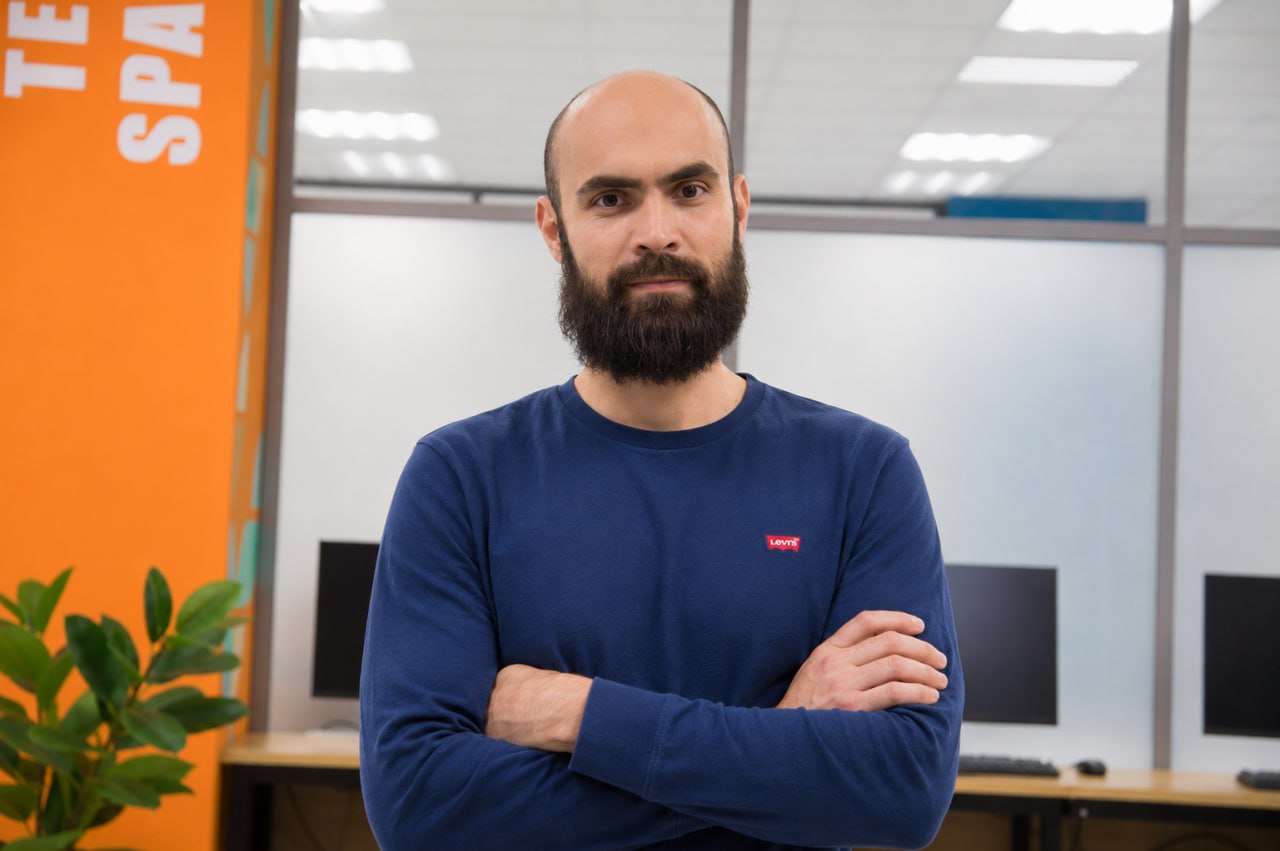





We spoke with Andrey, a Tech Orda graduate who decided to pursue a career in artificial intelligence after ten years in B2B sales and entrepreneurship. In the interview, he shared how the program helped him transition into product management, begin working on customer support automation, and develop solutions powered by AI agents and large language models.
Andrey, tell us a little about yourself. What did you do before joining Tech Orda?
— Before joining the program, most of my professional experience was in B2B sales and entrepreneurship, which I had been involved in for around ten years. I worked with corporate clients, launched my own projects, and developed a strong understanding of how business processes work from the inside.
Over time, I became increasingly interested in technology, particularly artificial intelligence. At some point, I realized that I did not want to simply use AI tools—I wanted to help create products powered by them.
Why did you decide to pursue a career in IT and apply for Tech Orda?
— I was drawn to the opportunity to combine my business experience with technology. Artificial intelligence was developing rapidly, and it was already clear that it could transform many familiar processes—from sales and customer support to marketing, analytics, and information management.
I wanted to gain a deeper understanding of the field and learn how to create such solutions myself. Tech Orda gave me an opportunity to enter the IT industry in a structured way and acquire the knowledge I needed for further professional growth.
What was the learning experience like, and what did you find most valuable?
— The most valuable aspect was that the program taught us not only about technology, but also about the product mindset: what problem we are solving, who actually needs the product, how to test a hypothesis, and how to evaluate the results.
During the program, we went through the entire journey—from developing an idea to designing an AI/ML solution—and completed practical assignments along the way. This helped me bring together previously fragmented knowledge and better understand how business, product development, data, and technology interact.
What challenges did you face, and how did you overcome them?
— The technical side was the greatest challenge for me. When you have spent a long time working in business and sales, many technical concepts initially seem like an entirely different world. I had to learn how to work with data, understand models and solution architecture, and gain insight into the development process.
I tried not to limit myself to the program curriculum. I studied new tools independently, created small projects, and experimented with artificial intelligence. Hands-on practice proved to be the most effective way to overcome this barrier and become more confident in the new field.
What was the main outcome for you after completing the program?
— The main outcome was that I fundamentally changed my career path. Before the program, artificial intelligence was primarily an area of strong personal interest for me. After completing the course, I began working as a product manager on an AI project and became involved in real products and business challenges.
In this way, Tech Orda helped me move from simply being interested in artificial intelligence to working with AI professionally.
How are you applying the knowledge you gained?
— Today, I work on automating customer support with artificial intelligence. I design AI agents, develop solutions that use large language models to search knowledge bases, structure corporate data and knowledge, and design the logic behind user interactions with AI. I also work on integrating these solutions into business processes.
At the same time, I continue developing my own projects, experimenting with AI agents and automation, and studying software development to gain a deeper understanding of the technical side of product creation.
I am particularly interested in solutions where artificial intelligence does more than simply answer questions or generate content—where it can perform actual tasks and create measurable value for businesses.
What advice would you give to future Tech Orda participants?
— I would advise them not to wait until the end of the program before creating something of their own. Learn while simultaneously developing a small service, automation tool, chatbot, or AI agent—any project that solves a real problem. Practical experience is the fastest way to identify the gaps in your knowledge and understand which direction you should pursue next.
It is also important not to underestimate your previous professional experience. Transitioning into IT does not necessarily mean starting your career from scratch. Knowledge of business, sales, marketing, finance, or any other industry can become a major advantage when combined with new technological skills.
If you would also like to master an in-demand IT profession and study under the Tech Orda program, you can explore the available learning tracks and submit your application by September 7, 2026, on the Astana Hub website.
We spoke with Andrey, a Tech Orda graduate who decided to pursue a career in artificial intelligence after ten years in B2B sales and entrepreneurship. In the interview, he shared how the program helped him transition into product management, begin working on customer support automation, and develop solutions powered by AI agents and large language models.
Andrey, tell us a little about yourself. What did you do before joining Tech Orda?
— Before joining the program, most of my professional experience was in B2B sales and entrepreneurship, which I had been involved in for around ten years. I worked with corporate clients, launched my own projects, and developed a strong understanding of how business processes work from the inside.
Over time, I became increasingly interested in technology, particularly artificial intelligence. At some point, I realized that I did not want to simply use AI tools—I wanted to help create products powered by them.
Why did you decide to pursue a career in IT and apply for Tech Orda?
— I was drawn to the opportunity to combine my business experience with technology. Artificial intelligence was developing rapidly, and it was already clear that it could transform many familiar processes—from sales and customer support to marketing, analytics, and information management.
I wanted to gain a deeper understanding of the field and learn how to create such solutions myself. Tech Orda gave me an opportunity to enter the IT industry in a structured way and acquire the knowledge I needed for further professional growth.
What was the learning experience like, and what did you find most valuable?
— The most valuable aspect was that the program taught us not only about technology, but also about the product mindset: what problem we are solving, who actually needs the product, how to test a hypothesis, and how to evaluate the results.
During the program, we went through the entire journey—from developing an idea to designing an AI/ML solution—and completed practical assignments along the way. This helped me bring together previously fragmented knowledge and better understand how business, product development, data, and technology interact.
What challenges did you face, and how did you overcome them?
— The technical side was the greatest challenge for me. When you have spent a long time working in business and sales, many technical concepts initially seem like an entirely different world. I had to learn how to work with data, understand models and solution architecture, and gain insight into the development process.
I tried not to limit myself to the program curriculum. I studied new tools independently, created small projects, and experimented with artificial intelligence. Hands-on practice proved to be the most effective way to overcome this barrier and become more confident in the new field.
What was the main outcome for you after completing the program?
— The main outcome was that I fundamentally changed my career path. Before the program, artificial intelligence was primarily an area of strong personal interest for me. After completing the course, I began working as a product manager on an AI project and became involved in real products and business challenges.
In this way, Tech Orda helped me move from simply being interested in artificial intelligence to working with AI professionally.
How are you applying the knowledge you gained?
— Today, I work on automating customer support with artificial intelligence. I design AI agents, develop solutions that use large language models to search knowledge bases, structure corporate data and knowledge, and design the logic behind user interactions with AI. I also work on integrating these solutions into business processes.
At the same time, I continue developing my own projects, experimenting with AI agents and automation, and studying software development to gain a deeper understanding of the technical side of product creation.
I am particularly interested in solutions where artificial intelligence does more than simply answer questions or generate content—where it can perform actual tasks and create measurable value for businesses.
What advice would you give to future Tech Orda participants?
— I would advise them not to wait until the end of the program before creating something of their own. Learn while simultaneously developing a small service, automation tool, chatbot, or AI agent—any project that solves a real problem. Practical experience is the fastest way to identify the gaps in your knowledge and understand which direction you should pursue next.
It is also important not to underestimate your previous professional experience. Transitioning into IT does not necessarily mean starting your career from scratch. Knowledge of business, sales, marketing, finance, or any other industry can become a major advantage when combined with new technological skills.
If you would also like to master an in-demand IT profession and study under the Tech Orda program, you can explore the available learning tracks and submit your application by September 7, 2026, on the Astana Hub website.
 Share
Share