






In Central Asia, this energy foundation is being shaped by Alageum Electric Group, one of the region’s largest manufacturers of electrical equipment. The company’s advanced transformers and digital substations help ensure grid stability while creating the conditions necessary for the growth of the digital economy. These technologies provide the infrastructure that enables the full-scale development of smart cities.
Technologies for Intelligent Power Grids
As digital economies continue to evolve, increasing attention is being paid to modern transformer technologies and intelligent power networks. Energy-efficient transformers have become one of the key building blocks of digital infrastructure.
Engineers at Kentau Transformer Plant, part of Alageum Electric Group, develop equipment designed to support the reliable operation of smart cities and intelligent energy systems.
Among the company’s most significant innovations is the TMGiN series of transformers, with capacities ranging from 25 to 2,500 kVA. By incorporating advanced materials and engineering solutions, these transformers significantly reduce both no-load and short-circuit losses. As a result, they improve overall grid efficiency while ensuring reliable power supply for digital infrastructure facilities.
The effectiveness of these solutions becomes particularly evident when compared with conventional transformers of previous generations. For example, a comparison between the standard TMG-630 transformer and the energy-efficient TMGiN-630 transformer equipped with an on-load voltage regulation system demonstrates substantial reductions in energy losses.
No-load losses decrease from 1,230 W to 486 W, representing a reduction of more than 60%, while short-circuit losses are reduced from 9,350 W to 4,283 W, a decrease of more than 54%.
These improvements have a direct impact on operating economics. Lower energy losses translate into reduced electricity costs for both consumers and utility companies. Across an entire power system, such efficiency gains contribute to lower overall energy consumption and significantly improved network performance.
Digital Substations and Intelligent Transformers
The next stage in the evolution of the energy sector is the transition from conventional equipment to digital and intelligent substations capable of managing power networks in real time.
One example is the TMGiN transformer equipped with an on-load tap changer, ECOTAP automatic voltage regulation, and digital monitoring capabilities. The system automatically maintains voltage stability under varying load conditions while enabling remote monitoring and operational control of the network.
The deployment of digital substations requires not only intelligent equipment but also continuous monitoring systems capable of assessing the technical condition of critical power assets.
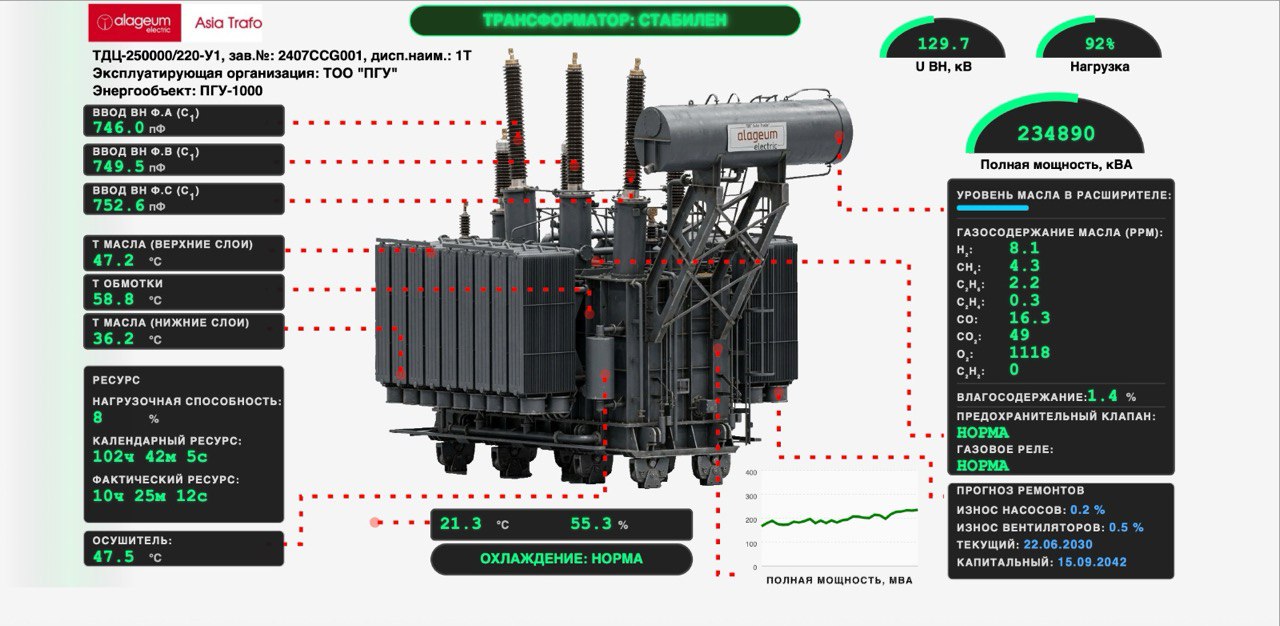
To address this need, engineers from Alageum Electric and Asia Trafo Transformer Plant, with the support of the Science Fund JSC, implemented a project focused on the development and production of a digital continuous-monitoring system for substation equipment.
As a result, Kazakhstan has developed and deployed a domestically engineered centralized transformer monitoring system. The solution enables real-time assessment of equipment performance during normal operation without requiring substation shutdowns or interruptions to power supply.
The system continuously collects and analyzes operational data from transformers, allowing potential faults to be detected at an early stage, preventing failures, and significantly improving power system reliability. Currently, no comparable locally developed solution exists in Kazakhstan.
The project has successfully progressed from research and development to full-scale industrial implementation. Supported through grant funding, the initiative completed the entire innovation cycle—from scientific research to production and commercialization. The system is now manufactured commercially and is deployed at substations operating at voltage levels of 220–500 kV, including critical energy infrastructure facilities.
The project also delivers substantial economic benefits. The domestically developed system costs 30–40% less than comparable foreign solutions. Its implementation reduces equipment failure rates, lowers operating expenses for utility companies, and strengthens technological independence within the energy sector. Manufacturing and maintenance are carried out entirely within Kazakhstan, further reducing dependence on imported technologies.
Artificial Intelligence in the Energy Sector
The digital transformation of the energy industry extends beyond equipment modernization. Another important area of development is the implementation of intelligent power system management solutions.
In this field, Ural Transformer Plant LLP, also part of Alageum Electric Group, is developing an AI-powered solar power generation forecasting system with grant support from the Science Fund JSC.
As the share of renewable energy sources continues to grow, accurate forecasting of electricity generation becomes increasingly critical. Solar energy production is highly dependent on weather conditions, and AI-driven data analytics can significantly improve generation forecasting, power plant scheduling, and grid management.
The project is being implemented by Ural Transformer Plant LLP, which serves as both the grant recipient and project operator. In the future, the developed solutions are expected to be deployed at energy facilities across Kazakhstan and other countries in the region.
The advancement of energy-efficient transformers, digital substations, continuous monitoring systems, and AI-powered grid management technologies is creating the technological foundation for the digital economy. This infrastructure forms the backbone of smart cities, sustainable energy systems, advanced data services, and the high-tech industries of the future.
In Central Asia, this energy foundation is being shaped by Alageum Electric Group, one of the region’s largest manufacturers of electrical equipment. The company’s advanced transformers and digital substations help ensure grid stability while creating the conditions necessary for the growth of the digital economy. These technologies provide the infrastructure that enables the full-scale development of smart cities.
Technologies for Intelligent Power Grids
As digital economies continue to evolve, increasing attention is being paid to modern transformer technologies and intelligent power networks. Energy-efficient transformers have become one of the key building blocks of digital infrastructure.
Engineers at Kentau Transformer Plant, part of Alageum Electric Group, develop equipment designed to support the reliable operation of smart cities and intelligent energy systems.
Among the company’s most significant innovations is the TMGiN series of transformers, with capacities ranging from 25 to 2,500 kVA. By incorporating advanced materials and engineering solutions, these transformers significantly reduce both no-load and short-circuit losses. As a result, they improve overall grid efficiency while ensuring reliable power supply for digital infrastructure facilities.
The effectiveness of these solutions becomes particularly evident when compared with conventional transformers of previous generations. For example, a comparison between the standard TMG-630 transformer and the energy-efficient TMGiN-630 transformer equipped with an on-load voltage regulation system demonstrates substantial reductions in energy losses.
No-load losses decrease from 1,230 W to 486 W, representing a reduction of more than 60%, while short-circuit losses are reduced from 9,350 W to 4,283 W, a decrease of more than 54%.
These improvements have a direct impact on operating economics. Lower energy losses translate into reduced electricity costs for both consumers and utility companies. Across an entire power system, such efficiency gains contribute to lower overall energy consumption and significantly improved network performance.
Digital Substations and Intelligent Transformers
The next stage in the evolution of the energy sector is the transition from conventional equipment to digital and intelligent substations capable of managing power networks in real time.
One example is the TMGiN transformer equipped with an on-load tap changer, ECOTAP automatic voltage regulation, and digital monitoring capabilities. The system automatically maintains voltage stability under varying load conditions while enabling remote monitoring and operational control of the network.
The deployment of digital substations requires not only intelligent equipment but also continuous monitoring systems capable of assessing the technical condition of critical power assets.
To address this need, engineers from Alageum Electric and Asia Trafo Transformer Plant, with the support of the Science Fund JSC, implemented a project focused on the development and production of a digital continuous-monitoring system for substation equipment.
As a result, Kazakhstan has developed and deployed a domestically engineered centralized transformer monitoring system. The solution enables real-time assessment of equipment performance during normal operation without requiring substation shutdowns or interruptions to power supply.
The system continuously collects and analyzes operational data from transformers, allowing potential faults to be detected at an early stage, preventing failures, and significantly improving power system reliability. Currently, no comparable locally developed solution exists in Kazakhstan.
The project has successfully progressed from research and development to full-scale industrial implementation. Supported through grant funding, the initiative completed the entire innovation cycle—from scientific research to production and commercialization. The system is now manufactured commercially and is deployed at substations operating at voltage levels of 220–500 kV, including critical energy infrastructure facilities.
The project also delivers substantial economic benefits. The domestically developed system costs 30–40% less than comparable foreign solutions. Its implementation reduces equipment failure rates, lowers operating expenses for utility companies, and strengthens technological independence within the energy sector. Manufacturing and maintenance are carried out entirely within Kazakhstan, further reducing dependence on imported technologies.
Artificial Intelligence in the Energy Sector
The digital transformation of the energy industry extends beyond equipment modernization. Another important area of development is the implementation of intelligent power system management solutions.
In this field, Ural Transformer Plant LLP, also part of Alageum Electric Group, is developing an AI-powered solar power generation forecasting system with grant support from the Science Fund JSC.
As the share of renewable energy sources continues to grow, accurate forecasting of electricity generation becomes increasingly critical. Solar energy production is highly dependent on weather conditions, and AI-driven data analytics can significantly improve generation forecasting, power plant scheduling, and grid management.
The project is being implemented by Ural Transformer Plant LLP, which serves as both the grant recipient and project operator. In the future, the developed solutions are expected to be deployed at energy facilities across Kazakhstan and other countries in the region.
The advancement of energy-efficient transformers, digital substations, continuous monitoring systems, and AI-powered grid management technologies is creating the technological foundation for the digital economy. This infrastructure forms the backbone of smart cities, sustainable energy systems, advanced data services, and the high-tech industries of the future.

 Share
Share