





The international technology forum AI & Digital Bridge 2026 has concluded in Astana. Held from October 1 to 3, the forum brought together technology business leaders, government representatives, international companies, investors, startup founders, developers, and industry experts.
The first day featured a special programme attended by government leaders, international delegations, and representatives of the technology industry. On October 2 and 3, AI & Digital Bridge continued with a programme open to the wider public.
The main theme of AI & Digital Bridge 2026 was “Kazakhstan is the Eurasian AI Hub.” The forum focused on Kazakhstan’s role in shaping the regional AI ecosystem, developing its own technology infrastructure, and strengthening international cooperation in artificial intelligence.
The two-day public programme attracted more than 47,000 visits. The combined total of daily unique visitors exceeded 18,000.
The conference programme featured 429 speakers, including 114 international experts, across 106 panel sessions. The exhibition showcased 96 startups in Startup Alley, 49 IT companies, and 42 individual booths. One of the forum’s key practical outcomes was the signing of 61 memoranda and agreements.
In 2026, the programme centred on artificial intelligence, computing infrastructure, large language models, robotics, technology entrepreneurship, investment, education, AI regulation, and the adoption of new solutions in the public and corporate sectors.
National leadership sets the strategic agenda
The central event of the special programme on October 1 was a plenary session attended by President of the Republic of Kazakhstan Kassym-Jomart Tokayev. The President outlined the key priorities for the country’s technological transformation and the role of artificial intelligence in the economy, science, education, and public administration.
“We are all witnessing how artificial intelligence technologies are fundamentally transforming industry, finance, education, science, public administration, and people’s way of life. With this in mind, the AI & Digital Bridge agenda evolves every year: new and relevant topics emerge, and the range of participants expands. Alongside digitalisation, the forum also hosts discussions on computing infrastructure, large language models, and robotics. Particular attention is paid to legislative regulation and safety in science and technology. AI & Digital Bridge thus effectively serves as a golden bridge for international engagement in new technologies,” said President Kassym-Jomart Tokayev.
The first day of the forum also marked the opening of Qazaq AI Research University (QAIRU). The President was introduced to its AI-Enabled University model and the new research university’s key development priorities. During the technology exhibition, he was also presented with digital and AI projects in education, public services, and industry.
The government agenda continued on the final day of the forum. On October 3, Prime Minister of the Republic of Kazakhstan Olzhas Bektenov explored the digital solutions presented at AI & Digital Bridge. He also met with representatives of the international technology industry and presented awards to the winners of the AI & Digital Bridge Awards 2026. Among the products demonstrated to the Prime Minister were QAIRU’s video and audio analytics solutions for education, an AI tutor, tools for analysing learning progress, and other AI products developed in Kazakhstan.
Kazakhstan is developing an AI economy across the entire value chain
One of the forum’s central themes was the development of a comprehensive artificial intelligence ecosystem in Kazakhstan. This encompasses the adoption of existing AI tools as well as the development of domestic infrastructure, computing capacity, language models, technology companies, and human capital, alongside conditions that support the growth of technology businesses and attract investment.
AI infrastructure development was also a key theme of Prime Minister Olzhas Bektenov’s remarks on the forum’s outcomes.
“At the opening of this forum, President Kassym-Jomart Tokayev emphasised that the development of new technologies has become an integral reality of a rapidly changing era. Kazakhstan has already established the necessary legal framework for the widespread adoption of AI. Digital infrastructure is developing at an accelerated pace. The ‘Data Centre Valley’ megaproject—the largest campus in Central Asia, with a potential power capacity of up to 1 GW—is now under active construction. These data centres will provide the foundation for artificial intelligence, cloud services, scientific research, and new digital industries. We are open to cooperation with global technology companies,” said Prime Minister Olzhas Bektenov.
Deputy Prime Minister and Minister of Artificial Intelligence and Digital Development of the Republic of Kazakhstan Zhaslan Madiyev noted that Kazakhstan is systematically developing every layer of the emerging AI economy.
“We are at the beginning of building a fully developed AI economy. According to various estimates, its total addressable market already exceeds $50 trillion. For Kazakhstan, this is an opportunity to secure its place in the new global economy and maximise the benefits of artificial intelligence. That is why we are systematically developing all five layers of the AI economy: from energy infrastructure, chips, and cloud platforms to our own language models and applications,” said Zhaslan Madiyev.
International expertise and new technology partnerships
Over two days, 106 panel sessions covered key areas of AI development: the new economy, global technology competition, investment, human capital, computing infrastructure, robotics, and Physical AI. The international programme brought together leading entrepreneurs, investors, researchers, executives from global technology companies, and representatives of government institutions.
Among the headline speakers at AI & Digital Bridge 2026 were Balaji Srinivasan, founder of Network School, entrepreneur, and investor, and Jamie Beaton, co-founder and CEO of Crimson Education. Their participation strengthened the forum’s international dimension and broadened discussions on technology entrepreneurship, education, talent development, and new models of development in the age of artificial intelligence.
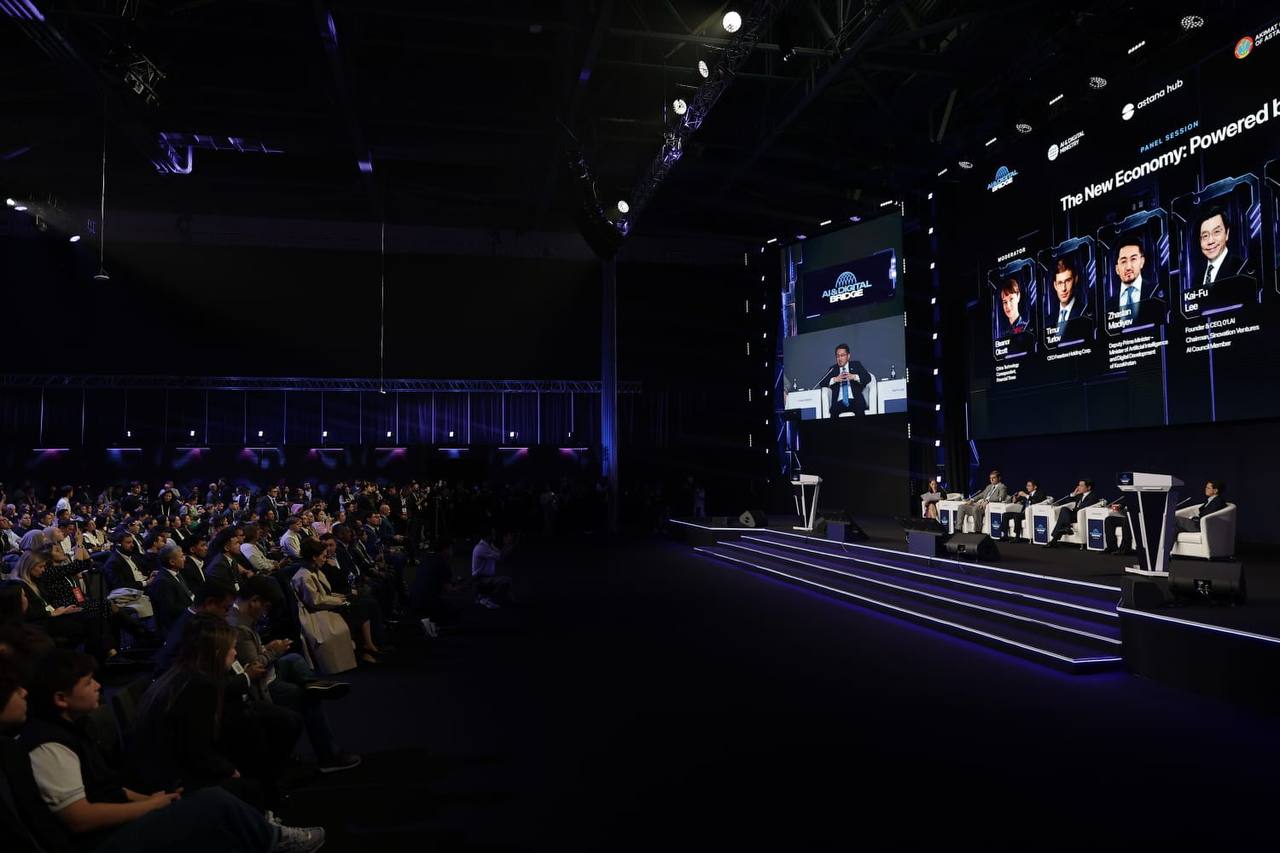
Another prominent participant in the international programme was Kai-Fu Lee, founder and CEO of 01.AI, chairman of Sinovation Ventures, and a member of the AI Council. He joined the The New Economy: Powered by AI session alongside Zhaslan Madiyev, Deputy Prime Minister and Minister of Artificial Intelligence and Digital Development of the Republic of Kazakhstan; Shervin Pishevar, founder and CEO of Sofreh Capital; Bagdat Mussin, Chairman of the Management Board of Kazakhtelecom JSC; and Timur Turlov, CEO of Freedom Holding Corp. Moderated by Eleanor Olcott, the discussion explored how artificial intelligence is transforming the global economy and what conditions are needed to build the new AI economy.
The session titled The New AI World Order examined the emerging global AI landscape and competition between technology models and approaches across different regions. Participants included Ya-Qin Zhang, founder of the Institute for AI Industry Research at Tsinghua University; Olaf Groth, founder of Cambrian Futures and a member of the AI Council; and Ian Slater, Executive Vice President at Mastercard. The discussion was moderated by Eleanor Olcott.
The investment agenda was explored during Capital for the AI Era. David Ripley, Co-CEO of Kraken; Pavel Nesterov, Executive Director of DS & AI at Revolut; Assel Tuleubayeva, co-founder of Alma; and Gaziz Seilkhanov, Head of Startup Acceleration and Venture Capital at Presight, discussed new growth opportunities, the transformation of investment strategies, and Central Eurasia’s place in the changing geography of investment. The session was moderated by Elizaveta Osetinskaya.
Human capital was another major focus of the programme. Who Will Power the AI Economy? featured Deemah AlYahya, Secretary-General of the Digital Cooperation Organization and a member of the AI Council; Tatev Aslanyan, Deputy Minister of High-Tech Industry and Artificial Intelligence of the Republic of Armenia; Richard Stirling, founder and CEO of Oxford Insights and a member of the AI Council; and Rev Lebaredian, Vice President of Physical AI Simulation at NVIDIA. The moderator was Paul Kim, former Associate Dean and CTO of the Stanford Graduate School of Education and a member of the AI Council. Participants discussed the skills that will shape the labour market in the AI economy and how education, science, government, and business should respond to technological change.
The future of artificial intelligence beyond generative models was the focus of The Next AI Frontier. Participants included Alexander Khanin, founder and CEO of Polynome Group and a member of the AI Council; Mérouane Debbah, Professor at Khalifa University and a member of the AI Council; Nicolas Sadirac, co-founder of 01Edu and 01Talent and a member of the AI Council; and Tariq Qureishy, who holds a PhD in AI and Global Transformation and is the founder and CEO of Future Readiness Forum & Xponential Group. Moderated by Atakan Varol, the session focused on robotics, Physical AI, autonomous systems, and the next stage in the development of intelligent technologies.
Other international participants in the AI & Digital Bridge 2026 programme included Greg Wyler, founder, CEO, and Chief Architect of E-Space; Sebastian Kurz, co-founder and President of Dream; Jon Huntsman, Vice Chairman and President of Strategic Growth at Mastercard; John Hopcroft, Turing Award laureate; Omar Al Olama, UAE Minister of Artificial Intelligence; Vivian Lee, Senior Lecturer at Harvard Medical School and former President of Health Platforms at Verily; and Liu Qingfeng, Chairman of iFLYTEK.
The forum programme also included workshops, masterclasses, Q&A sessions, technology demonstrations, startup pitches, and investor meetings. These practical formats enabled participants to share practical expertise, explore new solutions, connect with potential partners, and build professional and business relationships alongside discussions of global technological change.
“Today, Kazakhstan already has key foundations for developing its own AI economy and strengthening its position on the global technology stage: computing infrastructure and data centres are expanding, a strong technology ecosystem is taking shape, and we have talented developers, researchers, and startups. International participation in AI & Digital Bridge connects these strengths with global expertise, capital, and new partnerships. This is how we see the forum’s role—as a platform that helps Kazakhstan attract technology and talent and strengthen its position as the Eurasian AI hub. It is especially significant that the President recognised AI & Digital Bridge as a respected and widely known platform in Eurasia. For us, this is both a strong endorsement and a new benchmark for the forum’s continued development,” said Daniya Akhmetova, CEO of Digital Bridge.
The international programme of AI & Digital Bridge 2026 reflected the broad range of issues shaping today’s global AI agenda. The participation of international technology leaders, investors, researchers, and global companies connected international expertise with one of the forum’s central objectives: strengthening Kazakhstan’s position as the Eurasian AI hub and developing the country as a destination for technology, capital, and talent.
AI in the creative industries: AAIFF received more than 8,000 submissions from 125 countries
The application of artificial intelligence in film, music, and the creative industries held a prominent place in the AI MONTH programme. One of its key events was the international Astana AI Film Festival (AAIFF), dedicated to filmmaking using artificial intelligence technologies.
The Astana AI Film Festival took place on October 2, with President Kassym-Jomart Tokayev in attendance. The international competition received more than 8,000 submissions from 125 countries, including the United States, China, India, South Korea, the United Kingdom, Japan, and France.
AI in the creative industries was also explored in the AI & Digital Bridge 2026 programme. During AAIFF – The Future of AI Filmmaking and The Future of Live: Music, Concerts and AI, international and Kazakhstani experts discussed how artificial intelligence is transforming filmmaking, music, live entertainment, and content creation, as well as the new tools and opportunities it offers creators and creative teams.
96 startups, 49 IT companies, and international pavilions
The technology exhibition was a major component of AI & Digital Bridge 2026.
Startup Alley showcased 96 startups, while 49 IT companies presented their products and technology solutions. The exhibition also featured 42 individual booths.
Its international section included country pavilions representing Armenia, China, Spain, Canada, and Uzbekistan.
Four themed zones—Robotics, Art, GameDev, and Vibe Coding—were additional highlights. Visitors could explore robotics, gaming and VR projects, AI tools for creating digital products, and projects at the intersection of technology and the creative industries.
The exhibition provided a space for direct engagement between technology teams, companies, investors, prospective clients, and international partners.
Astana Hub Battle brought together startups from 14 countries
Astana Hub Battle 2026 was one of the central events of the startup programme.
“Astana Hub Battle is one of the forum’s most anticipated events, attracting technology entrepreneurs from different countries every year. In 2026, the competition received 292 applications from the United States, the UAE, Türkiye, Switzerland, Malaysia, and other countries. We see startups developing competitive solutions in artificial intelligence, healthcare, education, fintech, and other fields. These projects contribute to the knowledge economy, create jobs, and help turn innovative ideas into products that meet real demand,” said Magzhan Madiyev, General Director of Astana Hub.
Following several selection stages, 50 startups advanced to the semi-finals, and 14 teams earned the opportunity to present their projects in the final. Approximately 5% of all applicants reached the final stage.
Astana Hub Battle offered a $100,000 prize pool across four categories: Impact Maker, Market Shaper, Growth Engine, and Investor’s Choice. Each category offered a $25,000 prize.
Partners provided additional support. Kazakhtelecom allocated $25,000 worth of GPU resources, while Yandex Qazaqstan provided cloud resources worth KZT 10 million.
Of the 50 semi-finalists, 14 were selected for the final: CYBERPACK.AI, Aman, MYupgrade, Hi Doctor, Astana Dynamics, BEST Vision, Spacelab, Welcome Video AI, NCSpeech, Pulsar AI, AuaSense, M3TRIQ, Behype, and Resti.
Four startups were named winners of Astana Hub Battle 2026, each receiving $25,000: CYBERPACK.AI won Impact Maker, NCSpeech won Market Shaper, Astana Dynamics won Growth Engine, and Aman won Investor’s Choice.
In addition, Aman received a further $200,000 grant from MA7 Ventures. Competition partners also awarded technology resources to individual teams: Pulsar AI received KZT 10 million worth of cloud resources from Yandex Qazaqstan, while M3TRIQ received $25,000 worth of GPU resources from Kazakhtelecom.
The participating projects spanned artificial intelligence, HealthTech, EdTech, FinTech, robotics, industry, cybersecurity, logistics, environmental monitoring, and business process automation.
AI & Digital Bridge Awards recognised the year’s best technology projects
The AI & Digital Bridge Awards 2026 ceremony took place on October 3, with Prime Minister Olzhas Bektenov in attendance.
This year, the awards received 119 applications across seven categories. Selection took place in two stages. Applications were first analysed against established criteria using artificial intelligence technologies. The analysis produced a shortlist of five candidates in each category, after which an expert jury evaluated the projects.
The AI & Digital Bridge Awards 2026 winners were eGov.GPT for GovTech Project of the Year, GoPrep for EdTech Project of the Year, Rette for Startup of the Year, Aventa AI by QazCode for Corporate AI Transformation of the Year, Higgsfield AI for International Breakthrough of the Year, MA7 Ventures for VC of the Year, and ōzen for Creative Industry Project of the Year.
These projects have delivered tangible results. Kazakhstani HealthTech startup Rette has already launched pilot projects in the United States and been selected for Mayo Clinic Platform Accelerate. GoPrep has attracted more than 31,000 students from 139 countries. The music platform ōzen serves 2,364 artists and collected KZT 489 million in royalties on their behalf between 2019 and 2026.
Higgsfield AI won the international category. According to the information submitted for the awards, the platform has reached more than 30 million users across 238 countries and territories and raised approximately $550 million in investment.
The award results reflect the breadth of technology development in Kazakhstan, from public services and education to healthcare, corporate AI solutions, venture capital, and the creative economy.
The forum resulted in 61 memoranda and agreements
During the two days of the AI & Digital Bridge 2026 public programme, 61 memoranda and agreements were signed.
The agreements covered technology and investment cooperation, education, digital product development, and international partnerships.
Commenting on the forum’s outcomes, Prime Minister Olzhas Bektenov emphasised the need to move from individual successful solutions to technology adoption at scale.
“The next stage is the large-scale deployment of technologies that have demonstrated their effectiveness, alongside the introduction of new technologies and digital standards across our economy. To achieve this, government, the scientific community, and international technology companies must work together. Digital Bridge provides precisely the kind of platform that strengthens ties between business partners. This year, more than 60 new agreements were signed,” said Prime Minister Olzhas Bektenov.
The forum is therefore becoming a platform for developing concrete partnerships, launching joint projects, and expanding international business relationships alongside discussions of the technology agenda.
The forum attracted international media coverage
AI & Digital Bridge 2026 received extensive domestic and international media coverage. As part of a press tour organised by the Ministry of Foreign Affairs of the Republic of Kazakhstan, 17 representatives of foreign media attended the forum. A further 35 foreign media outlets received accreditation, with 10 representatives attending in person to cover the event. The international media pool encompassed more than 52 foreign outlets from 20 countries, including the United States, China, the United Kingdom, France, Japan, the Republic of Korea, the UAE, India, and countries across Central Asia, strengthening the international visibility of Kazakhstan and its AI ecosystem.
AI & Digital Bridge creates an environment for technology projects to grow
The outcomes of AI & Digital Bridge 2026 reflect the scale of the technology ecosystem developing around the forum: more than 47,000 visits; a combined total of daily unique visitors exceeding 18,000; 429 speakers, including 114 international experts; 106 panel sessions; 96 startups in Startup Alley; 49 IT companies; 42 individual booths; and 61 signed memoranda and agreements.
The forum’s significance also extends beyond these figures. AI & Digital Bridge connects government with technology businesses, startups with investors, developers with prospective clients, and Kazakhstani teams with international partners.
The opportunity to translate dialogue into concrete projects, connections with investors, technology solutions, and long-term partnerships is one of the forum’s principal outcomes. It provides a foundation for Kazakhstan’s continued development as one of the centres of Eurasia’s AI ecosystem.
AI & Digital Bridge 2026 took place on October 1–3 at the EXPO International Exhibition Centre in Astana. The forum was organised by the Ministry of Artificial Intelligence and Digital Development of the Republic of Kazakhstan, Astana Hub, and the Astana City Administration.
AI & Digital Bridge 2026 was made possible through the support of its partners and sponsors. All costs associated with the forum were covered by sponsorship funding:
GOLD PARTNERS: Freedom Bank, Kaspi Bank, Samruk-Kazyna JSC, Kazakhtelecom JSC.
SILVER PARTNER: Halyk Bank.
BUSINESS PARTNER: Beeline Kazakhstan.
BRONZE PARTNER: Yandex Qazaqstan.
DIGITAL PARTNERS: BI Group, Mastercard, Tengizchevroil, Baiterek National Investment Holding JSC, CITIX.
IMPACT PARTNERS: BI Innovations, Playrix Kazakhstan.
SMART PARTNER: Presight AI.
INNOVATION PARTNERS: KAZ Minerals, Bank CenterCredit, BCC-HUB, BTS Digital, Verigram, Lync & Co Kazakhstan.
ECOSYSTEM PARTNERS: Construction Management System, Comita Digital Technologies, BI Design Tech, Orientier Technologies, Solana.
CONTENT PARTNERS: Binance Kazakhstan, QazBot, inDrive.
SIDE EVENT PARTNERS: Dialog-Soft, DevRock, Movavi KZ, Performance Expert, FoodTech Engineering.
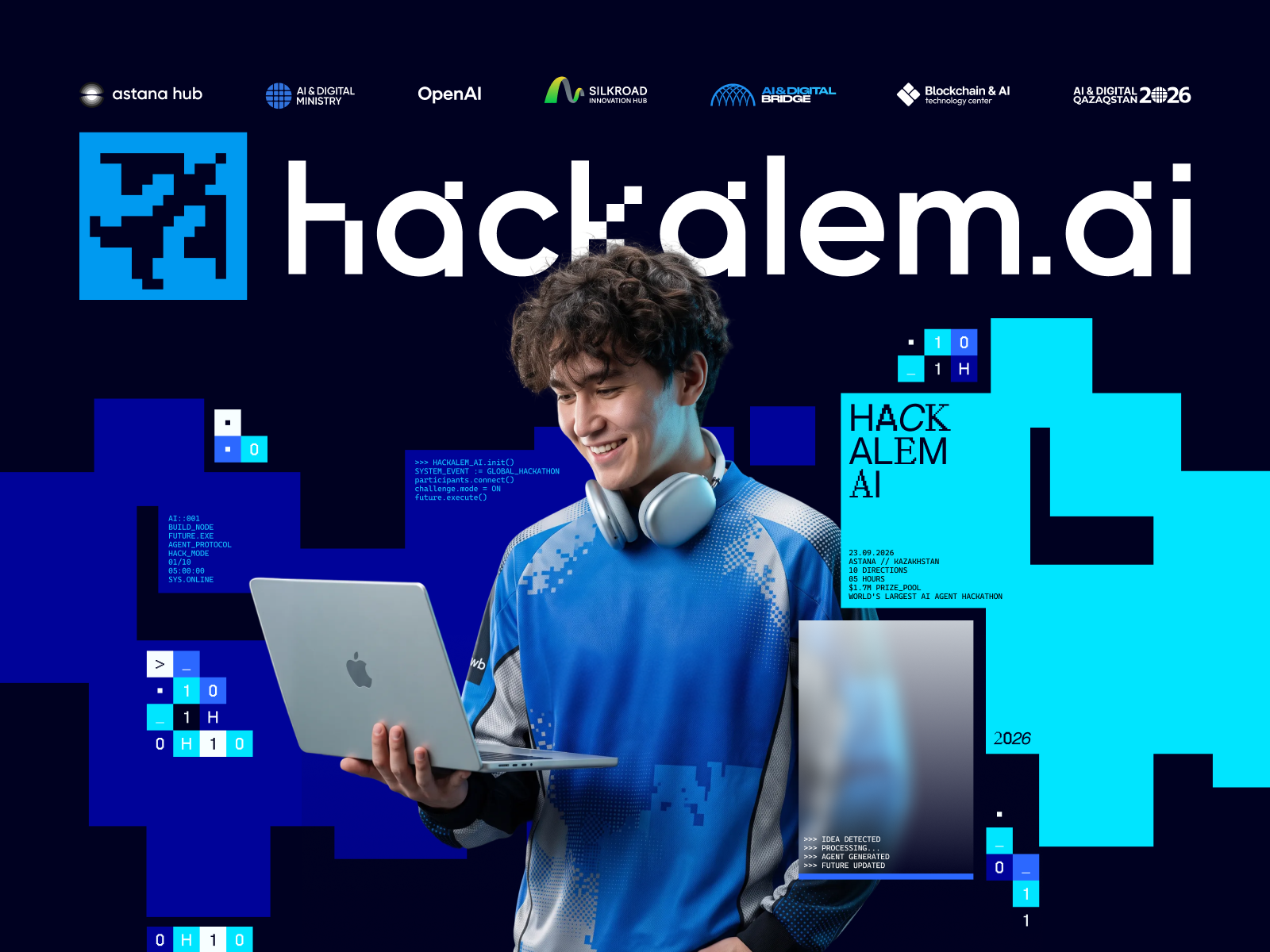
HACK ALEM AI PARTNER: Firebird AI KZ.
TELECOM PARTNER: Freedom Telecom Operations LLP.
TECH PARTNER: Transtelecom JSC.
OFFICIAL AIRLINE PARTNER: Air Astana.
The international technology forum AI & Digital Bridge 2026 has concluded in Astana. Held from October 1 to 3, the forum brought together technology business leaders, government representatives, international companies, investors, startup founders, developers, and industry experts.
The first day featured a special programme attended by government leaders, international delegations, and representatives of the technology industry. On October 2 and 3, AI & Digital Bridge continued with a programme open to the wider public.
The main theme of AI & Digital Bridge 2026 was “Kazakhstan is the Eurasian AI Hub.” The forum focused on Kazakhstan’s role in shaping the regional AI ecosystem, developing its own technology infrastructure, and strengthening international cooperation in artificial intelligence.
The two-day public programme attracted more than 47,000 visits. The combined total of daily unique visitors exceeded 18,000.
The conference programme featured 429 speakers, including 114 international experts, across 106 panel sessions. The exhibition showcased 96 startups in Startup Alley, 49 IT companies, and 42 individual booths. One of the forum’s key practical outcomes was the signing of 61 memoranda and agreements.
In 2026, the programme centred on artificial intelligence, computing infrastructure, large language models, robotics, technology entrepreneurship, investment, education, AI regulation, and the adoption of new solutions in the public and corporate sectors.
National leadership sets the strategic agenda
The central event of the special programme on October 1 was a plenary session attended by President of the Republic of Kazakhstan Kassym-Jomart Tokayev. The President outlined the key priorities for the country’s technological transformation and the role of artificial intelligence in the economy, science, education, and public administration.
“We are all witnessing how artificial intelligence technologies are fundamentally transforming industry, finance, education, science, public administration, and people’s way of life. With this in mind, the AI & Digital Bridge agenda evolves every year: new and relevant topics emerge, and the range of participants expands. Alongside digitalisation, the forum also hosts discussions on computing infrastructure, large language models, and robotics. Particular attention is paid to legislative regulation and safety in science and technology. AI & Digital Bridge thus effectively serves as a golden bridge for international engagement in new technologies,” said President Kassym-Jomart Tokayev.
The first day of the forum also marked the opening of Qazaq AI Research University (QAIRU). The President was introduced to its AI-Enabled University model and the new research university’s key development priorities. During the technology exhibition, he was also presented with digital and AI projects in education, public services, and industry.
The government agenda continued on the final day of the forum. On October 3, Prime Minister of the Republic of Kazakhstan Olzhas Bektenov explored the digital solutions presented at AI & Digital Bridge. He also met with representatives of the international technology industry and presented awards to the winners of the AI & Digital Bridge Awards 2026. Among the products demonstrated to the Prime Minister were QAIRU’s video and audio analytics solutions for education, an AI tutor, tools for analysing learning progress, and other AI products developed in Kazakhstan.
Kazakhstan is developing an AI economy across the entire value chain
One of the forum’s central themes was the development of a comprehensive artificial intelligence ecosystem in Kazakhstan. This encompasses the adoption of existing AI tools as well as the development of domestic infrastructure, computing capacity, language models, technology companies, and human capital, alongside conditions that support the growth of technology businesses and attract investment.
AI infrastructure development was also a key theme of Prime Minister Olzhas Bektenov’s remarks on the forum’s outcomes.
“At the opening of this forum, President Kassym-Jomart Tokayev emphasised that the development of new technologies has become an integral reality of a rapidly changing era. Kazakhstan has already established the necessary legal framework for the widespread adoption of AI. Digital infrastructure is developing at an accelerated pace. The ‘Data Centre Valley’ megaproject—the largest campus in Central Asia, with a potential power capacity of up to 1 GW—is now under active construction. These data centres will provide the foundation for artificial intelligence, cloud services, scientific research, and new digital industries. We are open to cooperation with global technology companies,” said Prime Minister Olzhas Bektenov.
Deputy Prime Minister and Minister of Artificial Intelligence and Digital Development of the Republic of Kazakhstan Zhaslan Madiyev noted that Kazakhstan is systematically developing every layer of the emerging AI economy.
“We are at the beginning of building a fully developed AI economy. According to various estimates, its total addressable market already exceeds $50 trillion. For Kazakhstan, this is an opportunity to secure its place in the new global economy and maximise the benefits of artificial intelligence. That is why we are systematically developing all five layers of the AI economy: from energy infrastructure, chips, and cloud platforms to our own language models and applications,” said Zhaslan Madiyev.
International expertise and new technology partnerships
Over two days, 106 panel sessions covered key areas of AI development: the new economy, global technology competition, investment, human capital, computing infrastructure, robotics, and Physical AI. The international programme brought together leading entrepreneurs, investors, researchers, executives from global technology companies, and representatives of government institutions.
Among the headline speakers at AI & Digital Bridge 2026 were Balaji Srinivasan, founder of Network School, entrepreneur, and investor, and Jamie Beaton, co-founder and CEO of Crimson Education. Their participation strengthened the forum’s international dimension and broadened discussions on technology entrepreneurship, education, talent development, and new models of development in the age of artificial intelligence.
Another prominent participant in the international programme was Kai-Fu Lee, founder and CEO of 01.AI, chairman of Sinovation Ventures, and a member of the AI Council. He joined the The New Economy: Powered by AI session alongside Zhaslan Madiyev, Deputy Prime Minister and Minister of Artificial Intelligence and Digital Development of the Republic of Kazakhstan; Shervin Pishevar, founder and CEO of Sofreh Capital; Bagdat Mussin, Chairman of the Management Board of Kazakhtelecom JSC; and Timur Turlov, CEO of Freedom Holding Corp. Moderated by Eleanor Olcott, the discussion explored how artificial intelligence is transforming the global economy and what conditions are needed to build the new AI economy.
The session titled The New AI World Order examined the emerging global AI landscape and competition between technology models and approaches across different regions. Participants included Ya-Qin Zhang, founder of the Institute for AI Industry Research at Tsinghua University; Olaf Groth, founder of Cambrian Futures and a member of the AI Council; and Ian Slater, Executive Vice President at Mastercard. The discussion was moderated by Eleanor Olcott.
The investment agenda was explored during Capital for the AI Era. David Ripley, Co-CEO of Kraken; Pavel Nesterov, Executive Director of DS & AI at Revolut; Assel Tuleubayeva, co-founder of Alma; and Gaziz Seilkhanov, Head of Startup Acceleration and Venture Capital at Presight, discussed new growth opportunities, the transformation of investment strategies, and Central Eurasia’s place in the changing geography of investment. The session was moderated by Elizaveta Osetinskaya.
Human capital was another major focus of the programme. Who Will Power the AI Economy? featured Deemah AlYahya, Secretary-General of the Digital Cooperation Organization and a member of the AI Council; Tatev Aslanyan, Deputy Minister of High-Tech Industry and Artificial Intelligence of the Republic of Armenia; Richard Stirling, founder and CEO of Oxford Insights and a member of the AI Council; and Rev Lebaredian, Vice President of Physical AI Simulation at NVIDIA. The moderator was Paul Kim, former Associate Dean and CTO of the Stanford Graduate School of Education and a member of the AI Council. Participants discussed the skills that will shape the labour market in the AI economy and how education, science, government, and business should respond to technological change.
The future of artificial intelligence beyond generative models was the focus of The Next AI Frontier. Participants included Alexander Khanin, founder and CEO of Polynome Group and a member of the AI Council; Mérouane Debbah, Professor at Khalifa University and a member of the AI Council; Nicolas Sadirac, co-founder of 01Edu and 01Talent and a member of the AI Council; and Tariq Qureishy, who holds a PhD in AI and Global Transformation and is the founder and CEO of Future Readiness Forum & Xponential Group. Moderated by Atakan Varol, the session focused on robotics, Physical AI, autonomous systems, and the next stage in the development of intelligent technologies.
Other international participants in the AI & Digital Bridge 2026 programme included Greg Wyler, founder, CEO, and Chief Architect of E-Space; Sebastian Kurz, co-founder and President of Dream; Jon Huntsman, Vice Chairman and President of Strategic Growth at Mastercard; John Hopcroft, Turing Award laureate; Omar Al Olama, UAE Minister of Artificial Intelligence; Vivian Lee, Senior Lecturer at Harvard Medical School and former President of Health Platforms at Verily; and Liu Qingfeng, Chairman of iFLYTEK.
The forum programme also included workshops, masterclasses, Q&A sessions, technology demonstrations, startup pitches, and investor meetings. These practical formats enabled participants to share practical expertise, explore new solutions, connect with potential partners, and build professional and business relationships alongside discussions of global technological change.
“Today, Kazakhstan already has key foundations for developing its own AI economy and strengthening its position on the global technology stage: computing infrastructure and data centres are expanding, a strong technology ecosystem is taking shape, and we have talented developers, researchers, and startups. International participation in AI & Digital Bridge connects these strengths with global expertise, capital, and new partnerships. This is how we see the forum’s role—as a platform that helps Kazakhstan attract technology and talent and strengthen its position as the Eurasian AI hub. It is especially significant that the President recognised AI & Digital Bridge as a respected and widely known platform in Eurasia. For us, this is both a strong endorsement and a new benchmark for the forum’s continued development,” said Daniya Akhmetova, CEO of Digital Bridge.
The international programme of AI & Digital Bridge 2026 reflected the broad range of issues shaping today’s global AI agenda. The participation of international technology leaders, investors, researchers, and global companies connected international expertise with one of the forum’s central objectives: strengthening Kazakhstan’s position as the Eurasian AI hub and developing the country as a destination for technology, capital, and talent.
AI in the creative industries: AAIFF received more than 8,000 submissions from 125 countries
The application of artificial intelligence in film, music, and the creative industries held a prominent place in the AI MONTH programme. One of its key events was the international Astana AI Film Festival (AAIFF), dedicated to filmmaking using artificial intelligence technologies.
The Astana AI Film Festival took place on October 2, with President Kassym-Jomart Tokayev in attendance. The international competition received more than 8,000 submissions from 125 countries, including the United States, China, India, South Korea, the United Kingdom, Japan, and France.
AI in the creative industries was also explored in the AI & Digital Bridge 2026 programme. During AAIFF – The Future of AI Filmmaking and The Future of Live: Music, Concerts and AI, international and Kazakhstani experts discussed how artificial intelligence is transforming filmmaking, music, live entertainment, and content creation, as well as the new tools and opportunities it offers creators and creative teams.
96 startups, 49 IT companies, and international pavilions
The technology exhibition was a major component of AI & Digital Bridge 2026.
Startup Alley showcased 96 startups, while 49 IT companies presented their products and technology solutions. The exhibition also featured 42 individual booths.
Its international section included country pavilions representing Armenia, China, Spain, Canada, and Uzbekistan.
Four themed zones—Robotics, Art, GameDev, and Vibe Coding—were additional highlights. Visitors could explore robotics, gaming and VR projects, AI tools for creating digital products, and projects at the intersection of technology and the creative industries.
The exhibition provided a space for direct engagement between technology teams, companies, investors, prospective clients, and international partners.
Astana Hub Battle brought together startups from 14 countries
Astana Hub Battle 2026 was one of the central events of the startup programme.
“Astana Hub Battle is one of the forum’s most anticipated events, attracting technology entrepreneurs from different countries every year. In 2026, the competition received 292 applications from the United States, the UAE, Türkiye, Switzerland, Malaysia, and other countries. We see startups developing competitive solutions in artificial intelligence, healthcare, education, fintech, and other fields. These projects contribute to the knowledge economy, create jobs, and help turn innovative ideas into products that meet real demand,” said Magzhan Madiyev, General Director of Astana Hub.
Following several selection stages, 50 startups advanced to the semi-finals, and 14 teams earned the opportunity to present their projects in the final. Approximately 5% of all applicants reached the final stage.
Astana Hub Battle offered a $100,000 prize pool across four categories: Impact Maker, Market Shaper, Growth Engine, and Investor’s Choice. Each category offered a $25,000 prize.
Partners provided additional support. Kazakhtelecom allocated $25,000 worth of GPU resources, while Yandex Qazaqstan provided cloud resources worth KZT 10 million.
Of the 50 semi-finalists, 14 were selected for the final: CYBERPACK.AI, Aman, MYupgrade, Hi Doctor, Astana Dynamics, BEST Vision, Spacelab, Welcome Video AI, NCSpeech, Pulsar AI, AuaSense, M3TRIQ, Behype, and Resti.
Four startups were named winners of Astana Hub Battle 2026, each receiving $25,000: CYBERPACK.AI won Impact Maker, NCSpeech won Market Shaper, Astana Dynamics won Growth Engine, and Aman won Investor’s Choice.
In addition, Aman received a further $200,000 grant from MA7 Ventures. Competition partners also awarded technology resources to individual teams: Pulsar AI received KZT 10 million worth of cloud resources from Yandex Qazaqstan, while M3TRIQ received $25,000 worth of GPU resources from Kazakhtelecom.
The participating projects spanned artificial intelligence, HealthTech, EdTech, FinTech, robotics, industry, cybersecurity, logistics, environmental monitoring, and business process automation.
AI & Digital Bridge Awards recognised the year’s best technology projects
The AI & Digital Bridge Awards 2026 ceremony took place on October 3, with Prime Minister Olzhas Bektenov in attendance.
This year, the awards received 119 applications across seven categories. Selection took place in two stages. Applications were first analysed against established criteria using artificial intelligence technologies. The analysis produced a shortlist of five candidates in each category, after which an expert jury evaluated the projects.
The AI & Digital Bridge Awards 2026 winners were eGov.GPT for GovTech Project of the Year, GoPrep for EdTech Project of the Year, Rette for Startup of the Year, Aventa AI by QazCode for Corporate AI Transformation of the Year, Higgsfield AI for International Breakthrough of the Year, MA7 Ventures for VC of the Year, and ōzen for Creative Industry Project of the Year.
These projects have delivered tangible results. Kazakhstani HealthTech startup Rette has already launched pilot projects in the United States and been selected for Mayo Clinic Platform Accelerate. GoPrep has attracted more than 31,000 students from 139 countries. The music platform ōzen serves 2,364 artists and collected KZT 489 million in royalties on their behalf between 2019 and 2026.
Higgsfield AI won the international category. According to the information submitted for the awards, the platform has reached more than 30 million users across 238 countries and territories and raised approximately $550 million in investment.
The award results reflect the breadth of technology development in Kazakhstan, from public services and education to healthcare, corporate AI solutions, venture capital, and the creative economy.
The forum resulted in 61 memoranda and agreements
During the two days of the AI & Digital Bridge 2026 public programme, 61 memoranda and agreements were signed.
The agreements covered technology and investment cooperation, education, digital product development, and international partnerships.
Commenting on the forum’s outcomes, Prime Minister Olzhas Bektenov emphasised the need to move from individual successful solutions to technology adoption at scale.
“The next stage is the large-scale deployment of technologies that have demonstrated their effectiveness, alongside the introduction of new technologies and digital standards across our economy. To achieve this, government, the scientific community, and international technology companies must work together. Digital Bridge provides precisely the kind of platform that strengthens ties between business partners. This year, more than 60 new agreements were signed,” said Prime Minister Olzhas Bektenov.
The forum is therefore becoming a platform for developing concrete partnerships, launching joint projects, and expanding international business relationships alongside discussions of the technology agenda.
The forum attracted international media coverage
AI & Digital Bridge 2026 received extensive domestic and international media coverage. As part of a press tour organised by the Ministry of Foreign Affairs of the Republic of Kazakhstan, 17 representatives of foreign media attended the forum. A further 35 foreign media outlets received accreditation, with 10 representatives attending in person to cover the event. The international media pool encompassed more than 52 foreign outlets from 20 countries, including the United States, China, the United Kingdom, France, Japan, the Republic of Korea, the UAE, India, and countries across Central Asia, strengthening the international visibility of Kazakhstan and its AI ecosystem.
AI & Digital Bridge creates an environment for technology projects to grow
The outcomes of AI & Digital Bridge 2026 reflect the scale of the technology ecosystem developing around the forum: more than 47,000 visits; a combined total of daily unique visitors exceeding 18,000; 429 speakers, including 114 international experts; 106 panel sessions; 96 startups in Startup Alley; 49 IT companies; 42 individual booths; and 61 signed memoranda and agreements.
The forum’s significance also extends beyond these figures. AI & Digital Bridge connects government with technology businesses, startups with investors, developers with prospective clients, and Kazakhstani teams with international partners.
The opportunity to translate dialogue into concrete projects, connections with investors, technology solutions, and long-term partnerships is one of the forum’s principal outcomes. It provides a foundation for Kazakhstan’s continued development as one of the centres of Eurasia’s AI ecosystem.
AI & Digital Bridge 2026 took place on October 1–3 at the EXPO International Exhibition Centre in Astana. The forum was organised by the Ministry of Artificial Intelligence and Digital Development of the Republic of Kazakhstan, Astana Hub, and the Astana City Administration.
AI & Digital Bridge 2026 was made possible through the support of its partners and sponsors. All costs associated with the forum were covered by sponsorship funding:
GOLD PARTNERS: Freedom Bank, Kaspi Bank, Samruk-Kazyna JSC, Kazakhtelecom JSC.
SILVER PARTNER: Halyk Bank.
BUSINESS PARTNER: Beeline Kazakhstan.
BRONZE PARTNER: Yandex Qazaqstan.
DIGITAL PARTNERS: BI Group, Mastercard, Tengizchevroil, Baiterek National Investment Holding JSC, CITIX.
IMPACT PARTNERS: BI Innovations, Playrix Kazakhstan.
SMART PARTNER: Presight AI.
INNOVATION PARTNERS: KAZ Minerals, Bank CenterCredit, BCC-HUB, BTS Digital, Verigram, Lync & Co Kazakhstan.
ECOSYSTEM PARTNERS: Construction Management System, Comita Digital Technologies, BI Design Tech, Orientier Technologies, Solana.
CONTENT PARTNERS: Binance Kazakhstan, QazBot, inDrive.
SIDE EVENT PARTNERS: Dialog-Soft, DevRock, Movavi KZ, Performance Expert, FoodTech Engineering.
HACK ALEM AI PARTNER: Firebird AI KZ.
TELECOM PARTNER: Freedom Telecom Operations LLP.
TECH PARTNER: Transtelecom JSC.
OFFICIAL AIRLINE PARTNER: Air Astana.
 Share
Share