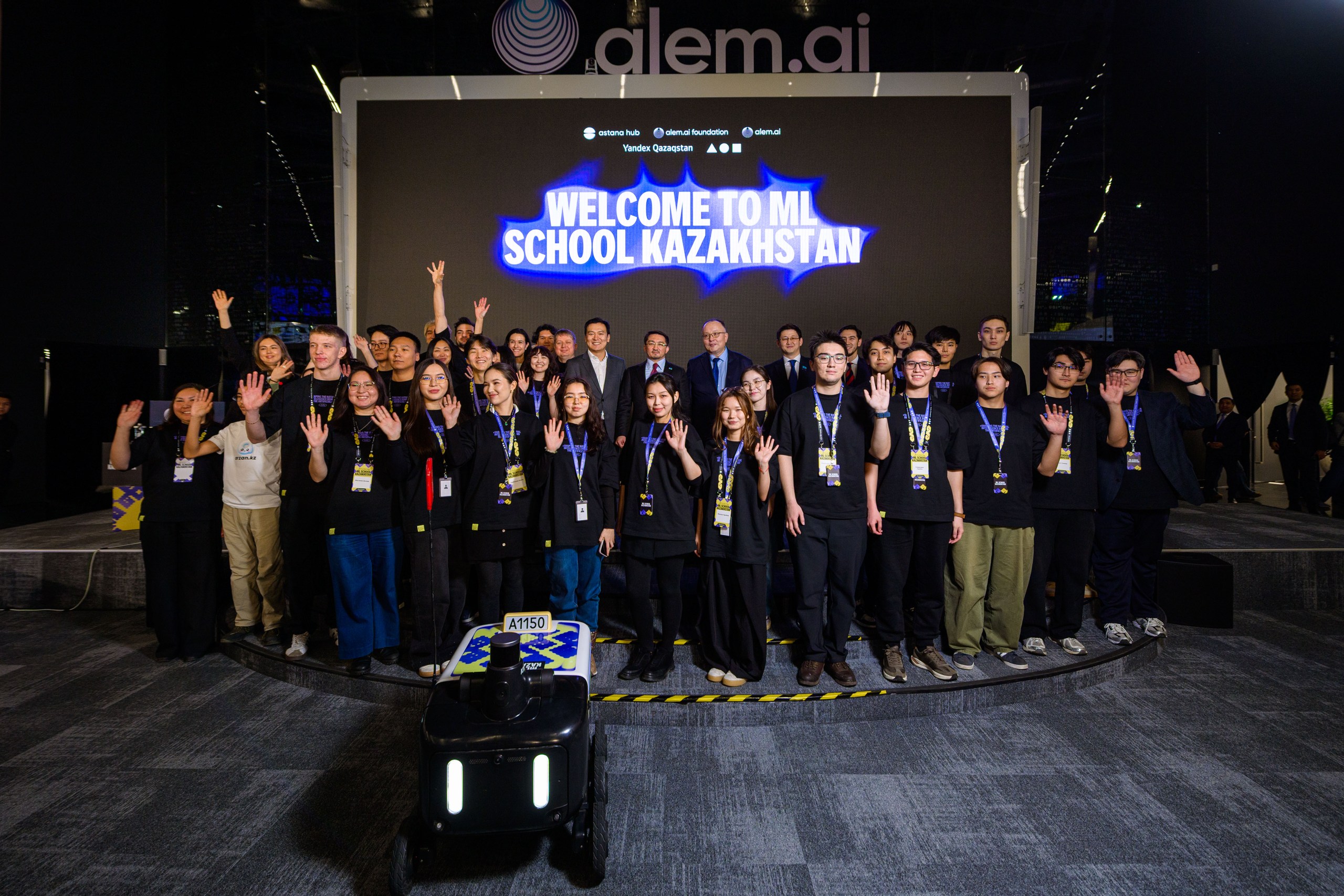





ML School Kazakhstan, a joint education programme run by Yandex Qazaqstan, Astana Hub and Alem.ai Foundation, has begun training its first cohort. Of more than 800 applicants, 32 were selected through a competitive two-stage process that included tests in mathematics and programming. Over two years, participants will study modern machine learning methods free of charge and learn to develop AI solutions for science, IT and a range of industries.
The first cohort includes specialists with experience developing large language models, applying machine learning in medicine and building AI technologies for the Kazakh language. Among them are a computer vision specialist who has worked on analysing CT scans and identifying pollen grains in microscope images, and a developer who has built models for correcting grammatical errors in Kazakh as well as tools for Kazakh speech recognition and synthesis. The cohort also includes specialists who have deployed machine learning models for tasks such as credit risk assessment and demand forecasting, along with researchers who use machine learning to analyse financial data.
“Designating 2026 as the Year of Digitalisation and Artificial Intelligence reflects Kazakhstan’s strategy to transform its economy through technology. Artificial intelligence opens up opportunities across a wide range of sectors, from industry, energy and agriculture to healthcare and public administration. Realising this potential requires both modern infrastructure and highly skilled specialists who can develop and deploy advanced technologies. ML School Kazakhstan shows how collaboration between educational institutions and technology companies can help train these specialists and support the continued development of the country’s digital economy,” said Zhaslan Madiyev, Deputy Prime Minister and Minister of Artificial Intelligence and Digital Development of the Republic of Kazakhstan.
Drawing on the academic approach and expertise of the Yandex School of Data Analysis, the programme combines foundational training with practical work. Participants will study mathematics, statistics, algorithms and machine learning, alongside technologies ranging from neural networks and computer vision to generative AI and natural language processing. Yandex experts, faculty from technical universities and researchers in machine learning and artificial intelligence will lead lectures and seminars.
“Advancing artificial intelligence depends on people who can build new technologies as well as use existing tools. ML School Kazakhstan received more than 800 applications for its first cohort, and only 32 candidates made it through the competitive selection process. This reflects strong interest in studying machine learning in depth and points to significant potential for Kazakhstan to develop its own AI expertise. We aim to build a community of highly skilled ML engineers and researchers who can create competitive AI products, develop research-intensive technologies and deploy solutions that can transform key sectors of the economy,” said Magzhan Madiyev, CEO of Astana Hub.
As part of their practical training, participants will meet machine learning specialists from leading technology companies in Kazakhstan, including Yandex Qazaqstan. They will examine real-world ML systems, study their architecture and the engineering decisions behind them, and work on applied and research problems. The programme also offers electives.
“At Yandex Qazaqstan, we apply machine learning in areas ranging from computer vision and recommendation systems to robotic delivery and autonomous vehicles. We want to share this experience with future specialists through ML School Kazakhstan. Our goal is to help participants gain the foundational knowledge and engineering skills they need to develop machine learning solutions independently and apply them across industries,” said Timur Shalekenov, Head of Yandex Qazaqstan.
Graduates of the two-year programme will receive a certificate from ML School Kazakhstan. Participants will also have the opportunity to take selected courses at the Yandex School of Data Analysis. Three-hour classes are held two or three times a week at the alem.ai International Centre for Artificial Intelligence in Astana.
“The very first intake at ML School Kazakhstan has already shown the depth of talent in Kazakhstan. Among the participants are specialists who are tackling complex engineering and research problems and already have achievements to their name. We want to give these specialists an environment where they can develop their abilities further. By bringing together rigorous academic training, international expertise and a professional community, we are helping the next generation of ML engineers and researchers grow,” said Adina Magavina, CEO of Alem.ai Foundation.
Yandex Qazaqstan, Astana Hub and Alem.ai Foundation plan to admit a new cohort to ML School Kazakhstan each year. The programme aims to train specialists who can apply machine learning to solve technical and practical problems and tackle research challenges.

 Share