




Kazakhstan's startup ecosystem is showing steady quantitative growth: since 2020, the number of startups in the study's database has grown almost fivefold, and about 60% of active startups were founded in the past four years. Venture funding has grown more than 23-fold and, according to RISE's forecast, can exceed $460 million in 2026. The market's next task is to move from quantitative growth to sustainable revenue and international expansion. Almost half of the startups surveyed name international markets as a priority, but not all manage to turn that interest into actual sales.
ASTANA, October 3, 2026 – Kazakhstan Startup Landscape 2026, the first national study of the country's startup ecosystem, was presented today at the AI & Digital Bridge 2026 forum. Covering more than 1,500 Kazakhstani startups, the study was prepared by the independent analytical agency RISE Research & Advisory together with Astana Hub and Sapa Group, with support from the Ministry of Artificial Intelligence and Digital Development of the Republic of Kazakhstan. It traces the path of a Kazakhstani startup from first sales to global scaling, examining what helps companies grow and what barriers they must overcome.
"Kazakhstan Startup Landscape 2026 provides an evidence-based view of the ecosystem and its key development trends. Such research is important for understanding where the ecosystem stands today, identifying areas with further potential, and supporting informed decisions by government, investors, corporations, and other ecosystem participants," said Zhaslan Madiyev, Deputy Prime Minister – Minister of Artificial Intelligence and Digital Development of the Republic of Kazakhstan.
Kazakhstan's Startup Ecosystem Gains Scale: 1,500+ Startups in the Database, a First Unicorn, and a Funding Forecast Above $460 Million
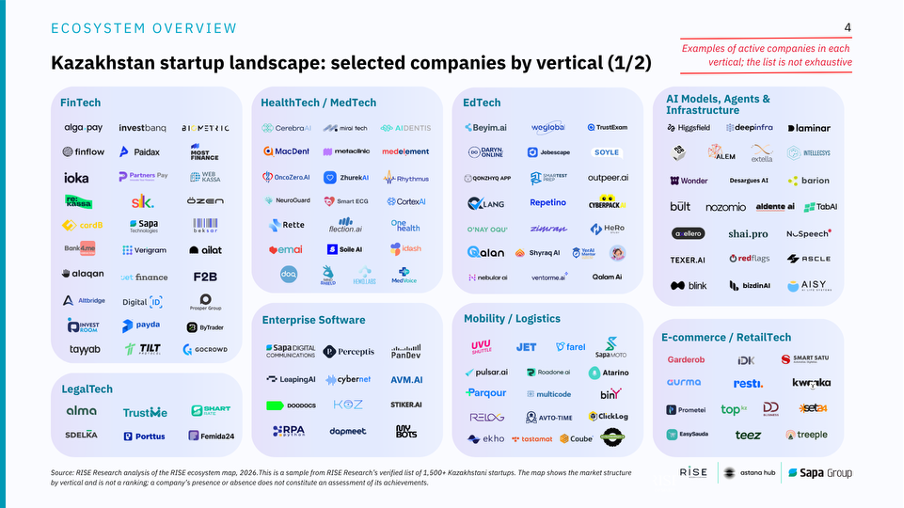
The number of startups in the study's database grew from roughly 300 in 2020 to more than 1,500 in 2026, although part of this growth may reflect the expanded coverage of the database itself.
Over the same period, venture funding tracked in the study increased from $20 million in 2020, and according to RISE’s forecast, can exceed $460 million in 2026. More than 200 companies in the database have raised venture funding, 45 of them more than $1 million, and one, Higgsfield AI, has reached unicorn (a startup valued at over $1 billion) status. Kazakhstan's national strategy, Digital Qazaqstan, calls for at least three Kazakhstani unicorns to reach global markets
by 2029.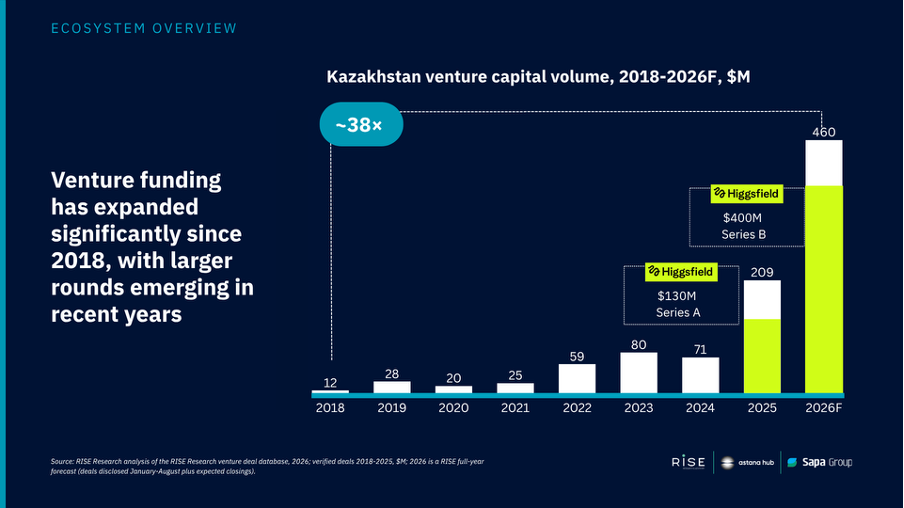
Kazakhstan's IT services exports grew from $35 million in 2020 to $1.1 billion in 2025, according to the National Bank of the Republic of Kazakhstan. The figure is not limited to product startups, but also includes other IT companies.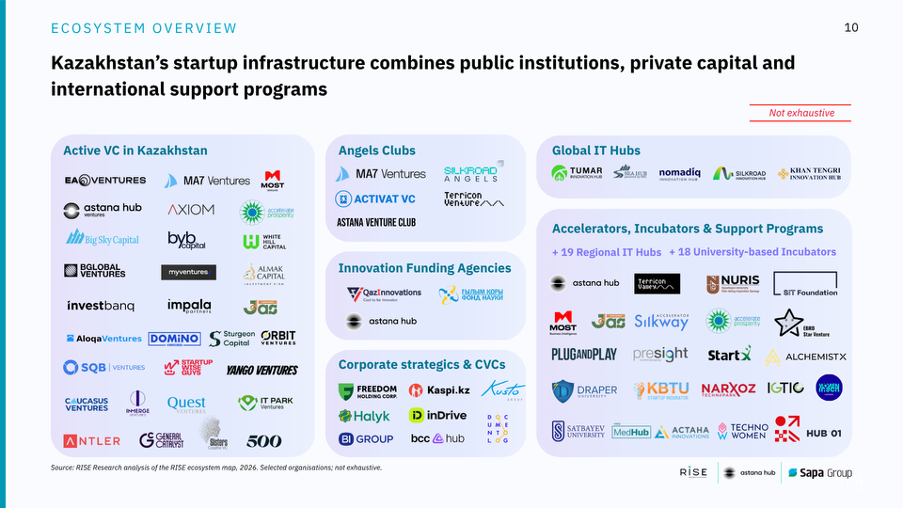
76% of Surveyed Startups With Revenue Earned Their First Income Within a Year, but Scaling Changes the Business Model
Among nearly 380 startups that already generate revenue and reported when it began, 76% reached first revenue within a year of launching their product, and about 52% did so within the first six months. These figures reflect how quickly companies reach first sales, but they do not mean that a company already has a viable or scalable model.
As a business grows, corporate customers play a larger role, making up about 53% of the customer base at early-stage companies and about 65% at scaling companies. Monetization also shifts: about 65% of early-stage companies use a subscription model (SaaS), compared with about 48% of scaling companies, where one-off sales of products, licenses, and implementation services account for a growing share.
82% of Surveyed Companies Use AI in Their Products
Artificial intelligence is part of the products of 82% of surveyed companies: 30% describe it as the core of their product, and another 52% use AI as a separate feature. However, using AI does not necessarily make a company an AI startup.
"A basic working AI product can be built in a matter of weeks today, so the technology itself is no longer an exclusive advantage. The main challenge for startups is moving toward durable, applied solutions, where data security and real unit economics come to the fore. Today the market pays for proven returns and reliability: investment in infrastructure and computing must pay off in tangible business impact, and the architecture must guarantee the protection of sensitive information, taking the local context into account. The winners are teams whose products don't just generate answers but close the gap between data and concrete action, directly affecting a business's P&L," said Aisha Prasheva, Director of Sapa Group.
47% of Early-Stage Startups Seek Access to Investors, While Scaling Companies Look to Corporate Customers and International Markets
Access to funding is most often cited as the main barrier while a company is building its first product. Once the first users appear, customer acquisition and sales take priority. About 47% of early-stage startups name access to investors as a priority. For scaling companies, the most sought-after needs are access to corporate customers (39%) and international visibility and PR (about 30%).
Interviews with founders of companies that have successfully reached the scaling stage show that growth does not rest on a single factor but on a combination of several. Founders most often spoke about trusted relationships and reputation, access to investors and customers through professional networks, and presence in the target market. They also pointed to customer growth and the ability to survive periods of extremely limited funding.
"The study shows how a startup's needs change as it develops: from funding to build a product to access to corporate clients and partners in foreign markets. For Astana Hub, it is important to build support around these stages, helping founders find customers, validate their business model, and prepare to scale. Acceleration, professional connections, and work with investors should lead to a concrete result: durable revenue and business growth. It is precisely companies' ability to create products people want and to compete internationally that defines the maturity of our ecosystem," said Rinata Ilyubayeva, Managing Director of Astana Hub.
40% of Scaling Companies Already Have Paying Customers Abroad, Compared With 16% of Early-Stage Companies
"Interest in international markets emerges among startups quite early: early-stage and scaling companies name foreign markets as a priority about equally often. But there is a noticeable gap between the intention to expand beyond Kazakhstan and actual sales. Scaling companies are two and a half times as likely to already have paying customers abroad. This shows that at more mature stages, what matters is no longer the fact of international plans but the ability to turn them into durable sales," said Ainur Zhanturina, Director of RISE Research & Advisory.
Methodology
The Kazakhstan Startup Landscape 2026 study draws on the RISE Research & Advisory database of more than 1,500 Kazakhstani startups and technology companies, a database of publicly disclosed venture deals from 2018 onward, a startup survey, and 30 in-depth interviews with founders of scaling companies. The survey received 682 responses; after verification and the merging of confirmed duplicate submissions, 602 valid responses were included in the analysis. The survey data describe the participating companies and are not a census of the entire ecosystem: the sample skews toward young companies and participants in ecosystem programs.
The full Kazakhstan Startup Landscape 2026 report is available on the RISE Research & Advisory website.
About the Companies
RISE Research & Advisory is an independent research and consulting agency specializing in technology markets and the new digital economy of Central Eurasia. RISE identifies key market signals and turns them into evidence-based analysis and practical recommendations, helping businesses, investors, and public institutions make informed strategic decisions.
Astana Hub is the largest international innovation cluster for IT startups in Central Eurasia.
Sapa Group is a Kazakhstani group of companies developing AI- and computer-vision-based solutions for FinTech, WorkTech, smart city, and mobility. Sapa Group is trusted by more than 300 partners across Central Asia. Combining technology with industry expertise, the group delivers end-to-end customer experience (CX) and ecosystem products for banks, telecom operators, and the real economy across the region.
Kazakhstan's startup ecosystem is showing steady quantitative growth: since 2020, the number of startups in the study's database has grown almost fivefold, and about 60% of active startups were founded in the past four years. Venture funding has grown more than 23-fold and, according to RISE's forecast, can exceed $460 million in 2026. The market's next task is to move from quantitative growth to sustainable revenue and international expansion. Almost half of the startups surveyed name international markets as a priority, but not all manage to turn that interest into actual sales.
ASTANA, October 3, 2026 – Kazakhstan Startup Landscape 2026, the first national study of the country's startup ecosystem, was presented today at the AI & Digital Bridge 2026 forum. Covering more than 1,500 Kazakhstani startups, the study was prepared by the independent analytical agency RISE Research & Advisory together with Astana Hub and Sapa Group, with support from the Ministry of Artificial Intelligence and Digital Development of the Republic of Kazakhstan. It traces the path of a Kazakhstani startup from first sales to global scaling, examining what helps companies grow and what barriers they must overcome.
"Kazakhstan Startup Landscape 2026 provides an evidence-based view of the ecosystem and its key development trends. Such research is important for understanding where the ecosystem stands today, identifying areas with further potential, and supporting informed decisions by government, investors, corporations, and other ecosystem participants," said Zhaslan Madiyev, Deputy Prime Minister – Minister of Artificial Intelligence and Digital Development of the Republic of Kazakhstan.
Kazakhstan's Startup Ecosystem Gains Scale: 1,500+ Startups in the Database, a First Unicorn, and a Funding Forecast Above $460 Million
The number of startups in the study's database grew from roughly 300 in 2020 to more than 1,500 in 2026, although part of this growth may reflect the expanded coverage of the database itself.
Over the same period, venture funding tracked in the study increased from $20 million in 2020, and according to RISE’s forecast, can exceed $460 million in 2026. More than 200 companies in the database have raised venture funding, 45 of them more than $1 million, and one, Higgsfield AI, has reached unicorn (a startup valued at over $1 billion) status. Kazakhstan's national strategy, Digital Qazaqstan, calls for at least three Kazakhstani unicorns to reach global markets
by 2029.
Kazakhstan's IT services exports grew from $35 million in 2020 to $1.1 billion in 2025, according to the National Bank of the Republic of Kazakhstan. The figure is not limited to product startups, but also includes other IT companies.
76% of Surveyed Startups With Revenue Earned Their First Income Within a Year, but Scaling Changes the Business Model
Among nearly 380 startups that already generate revenue and reported when it began, 76% reached first revenue within a year of launching their product, and about 52% did so within the first six months. These figures reflect how quickly companies reach first sales, but they do not mean that a company already has a viable or scalable model.
As a business grows, corporate customers play a larger role, making up about 53% of the customer base at early-stage companies and about 65% at scaling companies. Monetization also shifts: about 65% of early-stage companies use a subscription model (SaaS), compared with about 48% of scaling companies, where one-off sales of products, licenses, and implementation services account for a growing share.
82% of Surveyed Companies Use AI in Their Products
Artificial intelligence is part of the products of 82% of surveyed companies: 30% describe it as the core of their product, and another 52% use AI as a separate feature. However, using AI does not necessarily make a company an AI startup.
"A basic working AI product can be built in a matter of weeks today, so the technology itself is no longer an exclusive advantage. The main challenge for startups is moving toward durable, applied solutions, where data security and real unit economics come to the fore. Today the market pays for proven returns and reliability: investment in infrastructure and computing must pay off in tangible business impact, and the architecture must guarantee the protection of sensitive information, taking the local context into account. The winners are teams whose products don't just generate answers but close the gap between data and concrete action, directly affecting a business's P&L," said Aisha Prasheva, Director of Sapa Group.
47% of Early-Stage Startups Seek Access to Investors, While Scaling Companies Look to Corporate Customers and International Markets
Access to funding is most often cited as the main barrier while a company is building its first product. Once the first users appear, customer acquisition and sales take priority. About 47% of early-stage startups name access to investors as a priority. For scaling companies, the most sought-after needs are access to corporate customers (39%) and international visibility and PR (about 30%).
Interviews with founders of companies that have successfully reached the scaling stage show that growth does not rest on a single factor but on a combination of several. Founders most often spoke about trusted relationships and reputation, access to investors and customers through professional networks, and presence in the target market. They also pointed to customer growth and the ability to survive periods of extremely limited funding.
"The study shows how a startup's needs change as it develops: from funding to build a product to access to corporate clients and partners in foreign markets. For Astana Hub, it is important to build support around these stages, helping founders find customers, validate their business model, and prepare to scale. Acceleration, professional connections, and work with investors should lead to a concrete result: durable revenue and business growth. It is precisely companies' ability to create products people want and to compete internationally that defines the maturity of our ecosystem," said Rinata Ilyubayeva, Managing Director of Astana Hub.
40% of Scaling Companies Already Have Paying Customers Abroad, Compared With 16% of Early-Stage Companies
"Interest in international markets emerges among startups quite early: early-stage and scaling companies name foreign markets as a priority about equally often. But there is a noticeable gap between the intention to expand beyond Kazakhstan and actual sales. Scaling companies are two and a half times as likely to already have paying customers abroad. This shows that at more mature stages, what matters is no longer the fact of international plans but the ability to turn them into durable sales," said Ainur Zhanturina, Director of RISE Research & Advisory.
Methodology
The Kazakhstan Startup Landscape 2026 study draws on the RISE Research & Advisory database of more than 1,500 Kazakhstani startups and technology companies, a database of publicly disclosed venture deals from 2018 onward, a startup survey, and 30 in-depth interviews with founders of scaling companies. The survey received 682 responses; after verification and the merging of confirmed duplicate submissions, 602 valid responses were included in the analysis. The survey data describe the participating companies and are not a census of the entire ecosystem: the sample skews toward young companies and participants in ecosystem programs.
The full Kazakhstan Startup Landscape 2026 report is available on the RISE Research & Advisory website.
About the Companies
RISE Research & Advisory is an independent research and consulting agency specializing in technology markets and the new digital economy of Central Eurasia. RISE identifies key market signals and turns them into evidence-based analysis and practical recommendations, helping businesses, investors, and public institutions make informed strategic decisions.
Astana Hub is the largest international innovation cluster for IT startups in Central Eurasia.
Sapa Group is a Kazakhstani group of companies developing AI- and computer-vision-based solutions for FinTech, WorkTech, smart city, and mobility. Sapa Group is trusted by more than 300 partners across Central Asia. Combining technology with industry expertise, the group delivers end-to-end customer experience (CX) and ecosystem products for banks, telecom operators, and the real economy across the region.

 Share
Share