





Kazakhstan is expanding support mechanisms for technology teams, covering AI product development, investment readiness and international market entry. Within the Astana Hub ecosystem, this work is supported by the AI’preneurs accelerator, the Astana Hub Ventures venture capital fund and Alem Ventures Fund, a fund of funds. In parallel, the Digital Nomad Residency initiative offers foreign IT professionals with in-demand skills a simplified pathway to obtaining a residence permit in Kazakhstan.
For aspiring AI startup founders, one of the first steps is joining AI’preneurs, Astana Hub’s flagship accelerator launched in 2024. The programme brings together professionals with technical and business backgrounds, helping them form teams and turn ideas into products with validated market demand.
The 14-week programme takes place in person at the alem.ai International Centre for Artificial Intelligence in Astana. During the first four weeks, the Founder Lab stage helps participants develop an entrepreneurial mindset, build teams and refine their ideas. The following ten weeks, delivered through the Core Accelerator, focus on validating product and business hypotheses, developing a minimum viable product (MVP), launching pilots and generating initial sales.
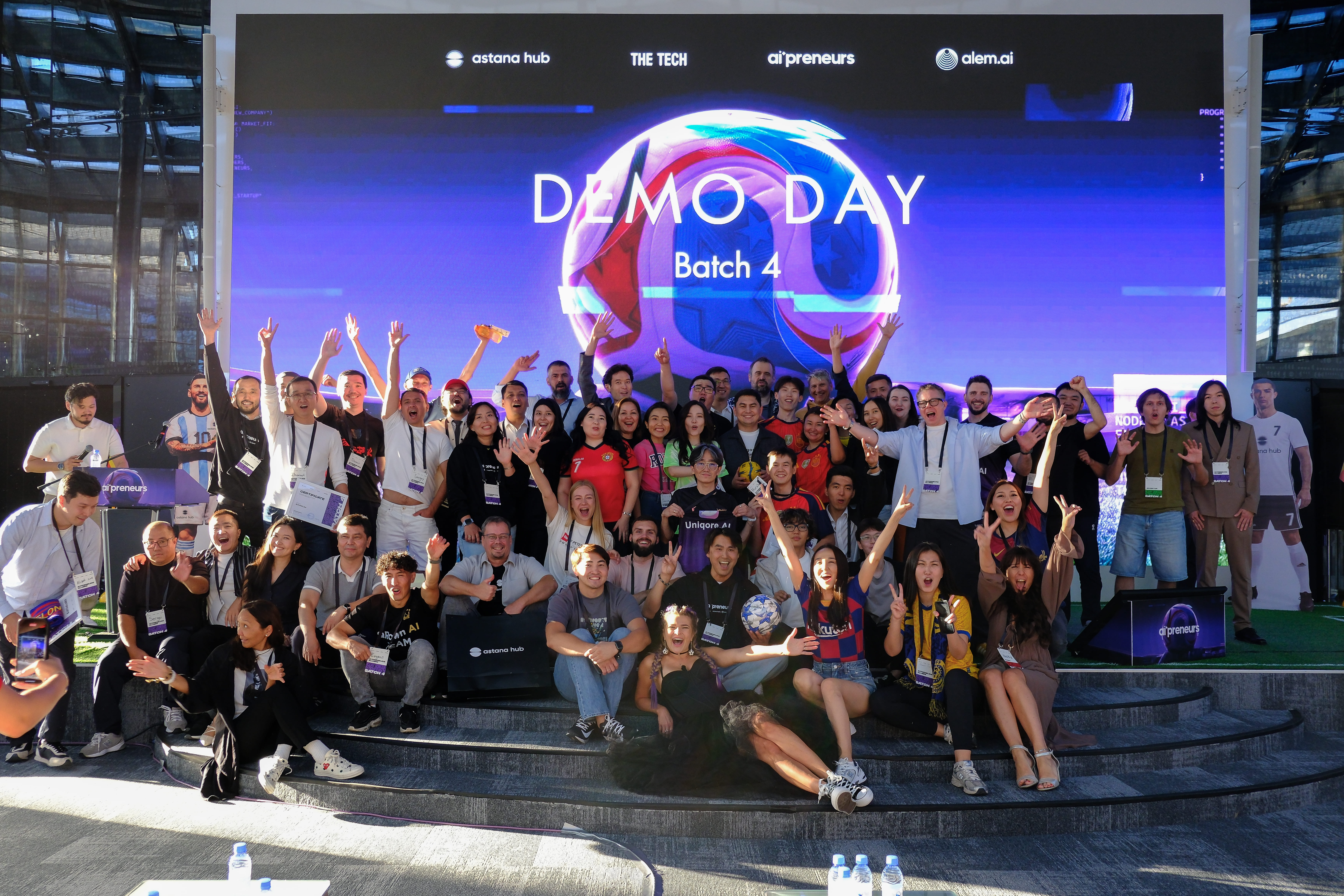
Throughout the accelerator, teams work with prospective customers, test their solutions against real-world challenges and refine their business models. Participants have access to alem.ai’s infrastructure, alem.plus technology resources and expert support. The programme culminates in Demo Day, where graduates present projects with a developed product, an established team and early market traction to investors and business partners.
Across four cohorts, AI’preneurs received 1,428 applications, selected 246 participants and graduated 50 startups. The first cohort attracted 250 applications, selected 52 participants and graduated nine startups; the second received 360 applications, selected 54 participants and graduated 13 startups; the third received 350 applications, selected 66 participants and graduated 12 startups; and the fourth received 468 applications, selected 74 participants and graduated 16 startups. Collectively, graduates have generated more than $618,000 in sales and raised $400,000 in investment.
Investment mechanisms complement the work of preparing teams for further growth. Astana Hub Ventures (AHV) invests in technology startups from Kazakhstan and Central Asia, providing capital for product development, business growth and international expansion. Alongside investment, startups receive expert support and access to Astana Hub’s partner network. The fund’s portfolio, including its accelerator portfolio, comprises 81 startups, with artificial intelligence and machine learning among its priority areas.
AHV’s notable AI investments include Higgsfield, Alma, Rette, Mirai Tech, Surfaice, Perceptis AI, PanDev Metrics and Axellero. Total support for these eight projects amounts to $3.45 million, comprising $2.7 million in cash investments and $750,000 in in-kind support, including expert guidance, consulting and business development assistance.
Astana Hub Ventures invested $500,000 in Higgsfield, a generative AI platform for creating and editing videos and images using text prompts and reference images. The platform enables users to apply visual effects, modify scene elements and automate video production. It serves content creators, marketers, brands, agencies and studios. In August 2026, the company raised $400 million in a Series B round at a valuation of $5.4 billion.
Another portfolio company, Alma, applies AI to the US immigration services market. Its co-founders are Assel Tuleubayeva from Kazakhstan and Aizada Marat from Kyrgyzstan. The platform helps employers and professionals navigate work visa and green card applications: AI tools analyse initial information and documents, organise application materials and automate routine tasks, while immigration lawyers handle the final legal work. In 2026, Alma raised $17 million in a Series A round.
In healthcare, Rette develops AI-powered solutions that analyse medical records, identify missing information and check documentation for compliance with clinical protocols and insurers’ requirements. In the United States, the product targets orthopaedic clinics: its AI extracts information about procedures performed, assigns medical codes and checks documentation for insurance claims. This helps reduce manual administrative work and errors in reimbursement submissions.
Mirai Tech operates at the intersection of technology, sport and rehabilitation. The company is developing a portable biomechanics laboratory built around smart sensor insoles and wearable devices. Sensors capture movement data, while AI analytics assess movement patterns, physical workload and recovery metrics. Sports teams, coaches and rehabilitation specialists use the solution to adjust training and recovery programmes based on real-world data.
Surfaice brings AI to construction and property management. The startup is developing an agent to manage the construction, opening and operation of stores and other retail properties. Working with documents and enterprise systems, it analyses leases, tracks payments and deadlines, reconciles invoices, helps prepare cost estimates and monitors construction work.
Perceptis AI also focuses on automating corporate tasks. The service turns text prompts into structured business presentations and produces strategy materials, financial reports and other corporate documents that can be edited in PowerPoint. The product automates part of the work performed by analysts and consultants. The company has raised a total of $3.6 million.
PanDev Metrics, meanwhile, helps companies analyse the performance of their IT teams. The platform combines data from development tools, repositories and task management systems to assess time spent, feature development costs and delivery speed. Its built-in AI assistant answers natural-language questions about metrics, presenting results as tables, charts and summaries.
Axellero enables users to create their own automation tools through a no-code/low-code platform for building AI agents and business applications in a visual builder using ready-made components. Users connect knowledge bases, define how agents operate and integrate them with enterprise systems, databases and external services. These agents automate customer support, data processing and internal workflows.
Alongside direct support for companies through Astana Hub Ventures, efforts are underway to develop the broader venture capital market. Alem Ventures Fund operates at this level as a fund of funds, acting as an institutional limited partner (LP) and allocating capital to leading and promising venture capital funds. These funds, in turn, invest in technology companies, including those in the rapidly growing AI sector.
This model brings together capital, expertise and access to international fund managers, or general partners (GPs), creating opportunities to scale investment further. Alem Ventures Fund combines strategic relationships with leading international funds, diversification and support for emerging fund managers, contributing to the development of the venture capital ecosystem across Central Asia and beyond.
Accelerator programmes, venture capital mechanisms and initiatives to attract international talent are creating the conditions for technology teams to grow in Kazakhstan. Together, they help bring expertise together, develop AI products that meet market needs and expand the international presence of Kazakhstani ventures.
Kazakhstan is expanding support mechanisms for technology teams, covering AI product development, investment readiness and international market entry. Within the Astana Hub ecosystem, this work is supported by the AI’preneurs accelerator, the Astana Hub Ventures venture capital fund and Alem Ventures Fund, a fund of funds. In parallel, the Digital Nomad Residency initiative offers foreign IT professionals with in-demand skills a simplified pathway to obtaining a residence permit in Kazakhstan.
For aspiring AI startup founders, one of the first steps is joining AI’preneurs, Astana Hub’s flagship accelerator launched in 2024. The programme brings together professionals with technical and business backgrounds, helping them form teams and turn ideas into products with validated market demand.
The 14-week programme takes place in person at the alem.ai International Centre for Artificial Intelligence in Astana. During the first four weeks, the Founder Lab stage helps participants develop an entrepreneurial mindset, build teams and refine their ideas. The following ten weeks, delivered through the Core Accelerator, focus on validating product and business hypotheses, developing a minimum viable product (MVP), launching pilots and generating initial sales.
Throughout the accelerator, teams work with prospective customers, test their solutions against real-world challenges and refine their business models. Participants have access to alem.ai’s infrastructure, alem.plus technology resources and expert support. The programme culminates in Demo Day, where graduates present projects with a developed product, an established team and early market traction to investors and business partners.
Across four cohorts, AI’preneurs received 1,428 applications, selected 246 participants and graduated 50 startups. The first cohort attracted 250 applications, selected 52 participants and graduated nine startups; the second received 360 applications, selected 54 participants and graduated 13 startups; the third received 350 applications, selected 66 participants and graduated 12 startups; and the fourth received 468 applications, selected 74 participants and graduated 16 startups. Collectively, graduates have generated more than $618,000 in sales and raised $400,000 in investment.
Investment mechanisms complement the work of preparing teams for further growth. Astana Hub Ventures (AHV) invests in technology startups from Kazakhstan and Central Asia, providing capital for product development, business growth and international expansion. Alongside investment, startups receive expert support and access to Astana Hub’s partner network. The fund’s portfolio, including its accelerator portfolio, comprises 81 startups, with artificial intelligence and machine learning among its priority areas.
AHV’s notable AI investments include Higgsfield, Alma, Rette, Mirai Tech, Surfaice, Perceptis AI, PanDev Metrics and Axellero. Total support for these eight projects amounts to $3.45 million, comprising $2.7 million in cash investments and $750,000 in in-kind support, including expert guidance, consulting and business development assistance.
Astana Hub Ventures invested $500,000 in Higgsfield, a generative AI platform for creating and editing videos and images using text prompts and reference images. The platform enables users to apply visual effects, modify scene elements and automate video production. It serves content creators, marketers, brands, agencies and studios. In August 2026, the company raised $400 million in a Series B round at a valuation of $5.4 billion.
Another portfolio company, Alma, applies AI to the US immigration services market. Its co-founders are Assel Tuleubayeva from Kazakhstan and Aizada Marat from Kyrgyzstan. The platform helps employers and professionals navigate work visa and green card applications: AI tools analyse initial information and documents, organise application materials and automate routine tasks, while immigration lawyers handle the final legal work. In 2026, Alma raised $17 million in a Series A round.
In healthcare, Rette develops AI-powered solutions that analyse medical records, identify missing information and check documentation for compliance with clinical protocols and insurers’ requirements. In the United States, the product targets orthopaedic clinics: its AI extracts information about procedures performed, assigns medical codes and checks documentation for insurance claims. This helps reduce manual administrative work and errors in reimbursement submissions.
Mirai Tech operates at the intersection of technology, sport and rehabilitation. The company is developing a portable biomechanics laboratory built around smart sensor insoles and wearable devices. Sensors capture movement data, while AI analytics assess movement patterns, physical workload and recovery metrics. Sports teams, coaches and rehabilitation specialists use the solution to adjust training and recovery programmes based on real-world data.
Surfaice brings AI to construction and property management. The startup is developing an agent to manage the construction, opening and operation of stores and other retail properties. Working with documents and enterprise systems, it analyses leases, tracks payments and deadlines, reconciles invoices, helps prepare cost estimates and monitors construction work.
Perceptis AI also focuses on automating corporate tasks. The service turns text prompts into structured business presentations and produces strategy materials, financial reports and other corporate documents that can be edited in PowerPoint. The product automates part of the work performed by analysts and consultants. The company has raised a total of $3.6 million.
PanDev Metrics, meanwhile, helps companies analyse the performance of their IT teams. The platform combines data from development tools, repositories and task management systems to assess time spent, feature development costs and delivery speed. Its built-in AI assistant answers natural-language questions about metrics, presenting results as tables, charts and summaries.
Axellero enables users to create their own automation tools through a no-code/low-code platform for building AI agents and business applications in a visual builder using ready-made components. Users connect knowledge bases, define how agents operate and integrate them with enterprise systems, databases and external services. These agents automate customer support, data processing and internal workflows.
Alongside direct support for companies through Astana Hub Ventures, efforts are underway to develop the broader venture capital market. Alem Ventures Fund operates at this level as a fund of funds, acting as an institutional limited partner (LP) and allocating capital to leading and promising venture capital funds. These funds, in turn, invest in technology companies, including those in the rapidly growing AI sector.
This model brings together capital, expertise and access to international fund managers, or general partners (GPs), creating opportunities to scale investment further. Alem Ventures Fund combines strategic relationships with leading international funds, diversification and support for emerging fund managers, contributing to the development of the venture capital ecosystem across Central Asia and beyond.
Accelerator programmes, venture capital mechanisms and initiatives to attract international talent are creating the conditions for technology teams to grow in Kazakhstan. Together, they help bring expertise together, develop AI products that meet market needs and expand the international presence of Kazakhstani ventures.

 Share
Share