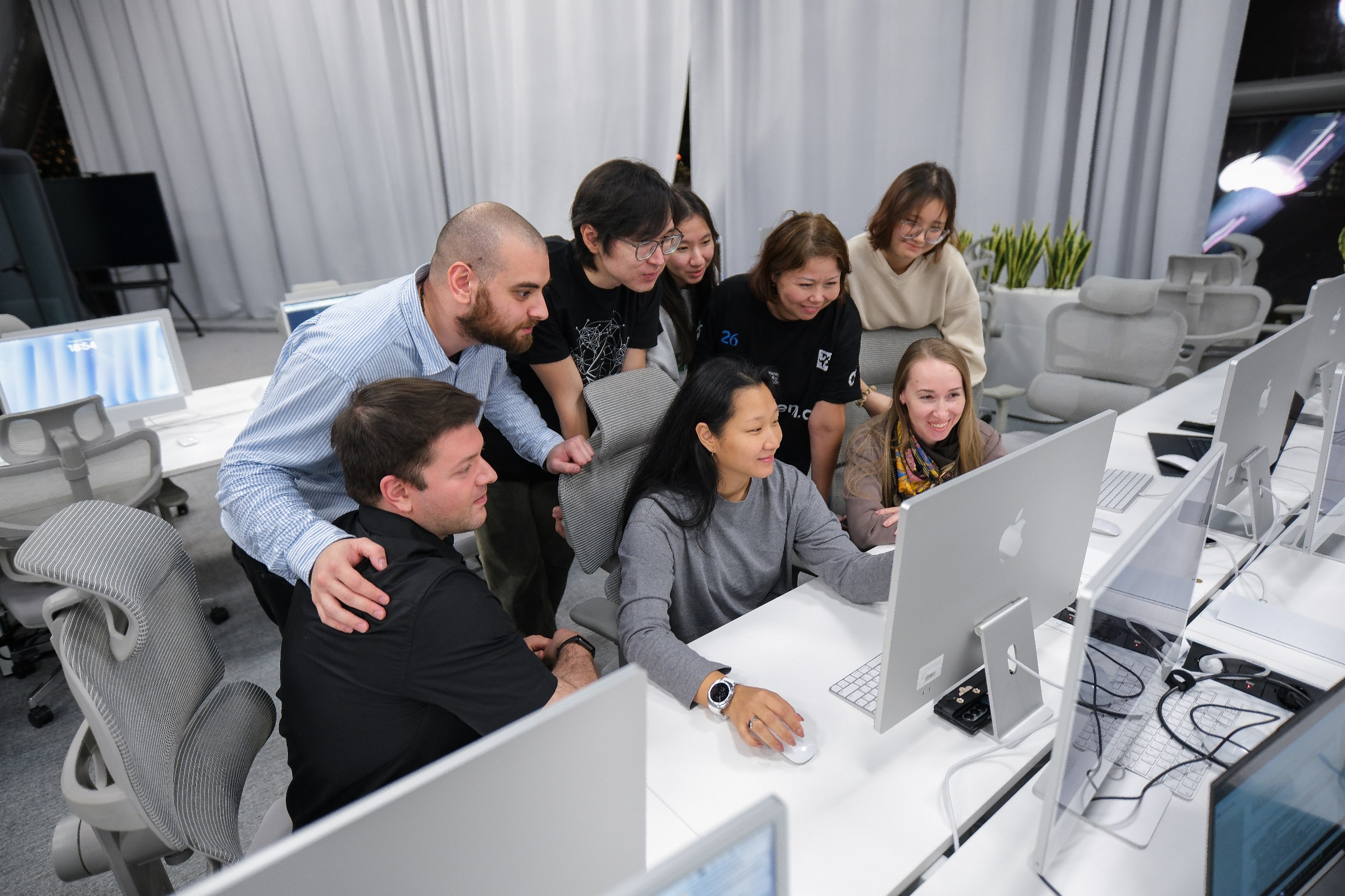





Tomorrow School, an artificial intelligence school launched with the support of Astana Hub, has announced the results of its first two years of operation. During this period, the school received more than 34,000 applications, and over 80 students secured IT roles before completing the programme. Today, the project is expanding its network of campuses across Kazakhstan, providing access to free education in programming and artificial intelligence.
Tomorrow School opened on 21 October 2024. The project is delivered by Alem.ai Foundation within the ecosystem of Astana Hub and the alem.ai International Centre for Artificial Intelligence. No relevant academic background or prior programming experience is required for admission.
“We want access to modern technology education to be independent of where people live or what career they previously chose. By expanding Tomorrow School into the regions, we are creating opportunities for people to develop IT and AI skills, connect with like-minded peers and work on their own solutions. It is important to us that these opportunities are available throughout Kazakhstan,” said Valeriya Te, Managing Director of Astana Hub.
Over the past two years, the Astana campus has received more than 24,000 applications. Over 2,100 participants have completed the intensive selection bootcamps, known as “piscines”. Today, 493 students are enrolled in the core programme in Astana. Their average age is 27, and they include university students, working professionals, freelancers and people from other fields seeking to transition into IT. Alongside students from Kazakhstan, the school welcomes participants from Uzbekistan, Azerbaijan, Russia, the United States and Germany.
The core programme lasts 18 months and includes more than 50 practical projects. Students learn algorithms, backend development and programming languages including Go, Python and JavaScript before progressing to machine learning, computer vision, natural language processing, large language models and recommendation systems.
“Learning at Tomorrow School is built around practical challenges. Students learn to find solutions independently, work in teams and see projects through to completion. We want them to understand how to apply the technologies they study in real work settings and to use these skills to advance their careers while still studying,” said Olzhas Urazalin, Head of the Tomorrow School Astana Office.
More than 80 students have already secured IT roles before completing the programme. The school’s students include interns and junior developers, senior specialists, team leads, chief technology officers and founders of their own companies.
One example of students putting their skills into practice is Nurlan Dyusembayev’s “Umny Zakup” (“Smart Procurement”) project, which won first place in the Logistics track at HackAlem AI. Competing individually, Nurlan received $5,000 in prize money and $5,000 worth of OpenAI tokens.
Smart Procurement helps businesses determine which products to order, in what quantities and when. The system analyses sales, inventory levels, goods in transit, seasonal patterns and large orders to generate a prioritised list of actions for procurement specialists. This approach helps reduce the risk of stock shortages and prevent excess inventory.
“For me, the most valuable aspect of Tomorrow School is the opportunity to learn by doing. In every project, you have to understand the problem yourself, find a solution and test how it works. If something does not work, we discuss it with other students and try different approaches. Gradually, you gain confidence: you realise you can apply your knowledge and create something of your own,” said Eleonora Ligay, a Tomorrow School student.
The next stage in Tomorrow School’s development has been the expansion of its regional network, with campuses hosted by universities, colleges and IT hubs. This work is being carried out in line with the President’s directives as part of the Year of Digitalisation and Artificial Intelligence.
Regional campuses operate in the Pavlodar, Akmola, Kostanay, West Kazakhstan, Turkestan, Aktobe, East Kazakhstan, North Kazakhstan, Karaganda, Zhambyl, Zhetysu and Abai regions, as well as in the city of Shymkent. These campuses have received more than 10,000 applications, with over 2,000 people taking part.
The expansion of Tomorrow School’s regional network aims to develop technology talent and strengthen local IT communities. The campuses bring together participants who are learning new professions, developing their own products and acquiring skills they can apply to challenges in their regions.
Tomorrow School’s continued development focuses on broadening access to IT and AI education and building technology communities throughout Kazakhstan. The project contributes to the country’s human capital development by helping people acquire in-demand skills, change careers and become more competitive in the labour market. Training these specialists builds the talent base needed to adopt artificial intelligence across economic sectors and develop homegrown technology products.

 Share