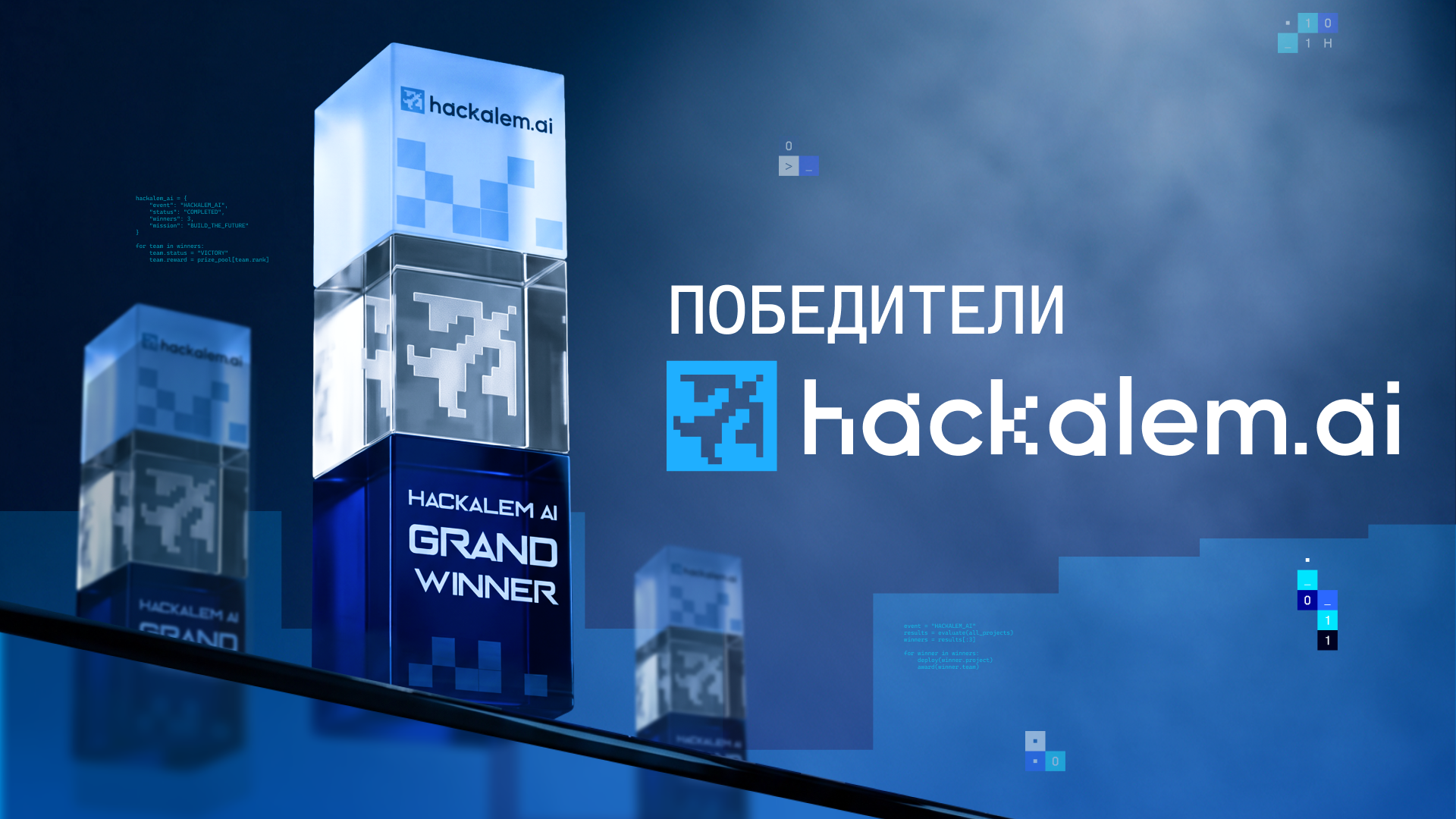





On October 16, the Demo Day of the international AI hackathon HackAlem AI took place. On September 23 in Astana, HackAlem AI set a new GUINNESS WORLD RECORDS™ title for the largest number of participants in an AI hackathon. HackAlem AI brought together 2,415 participants, surpassing the previous record set in India. During the final stage, 60 teams presented their solutions to an expert jury in an online format.
A total of 60 projects advanced to the final stage, selected by experts from 1,066 solutions. Demo Day was held entirely online. Each team was given up to five minutes to present its project and answer questions from the jury. Finalists presented their solutions exactly as they had been developed during HackAlem AI, without any subsequent product refinement. Participants were also able to demonstrate their solutions live during their pitches.
The final scores were based exclusively on the results of Demo Day: scores from the first stage were not taken into account when determining the winners. All finalists were evaluated again on equal terms according to the established criteria. The jury also included representatives directly connected to the challenges of the respective tracks. Participants could present their projects in Kazakh, Russian, or English.
Following Demo Day, winners were selected across 10 main tracks and two special tracks.
Winners of the Main Tracks
Telecommunications
1st place — PalliPalli — PalliPalli solution for Beeline, a tariff campaign agent.
2nd place — Flora — an agent for tariff marketing campaigns.
3rd place — andreidev — Campaign Cockpit, an AI assistant for telecom operators that determines which tariff to offer to which customers and tests its hypotheses.
Finance
1st place — TAMYR — Money Graph, a tool for AML analysts that builds a graph of money transfers, identifies participants’ roles, and indicates who should be investigated first.
2nd place — UNRU AI — MoneyGraph Investigator, a system for analyzing money transfer networks that identifies priority nodes for investigation and explains hypotheses about their roles.
3rd place — Neverlose — a money transfer analysis system that builds a graph of connections, proposes hypotheses about participants’ roles, and helps prioritize investigations.
Logistics
1st place — Light — Smart Procurement, a system that predicts product shortages before they disrupt sales.
2nd place — ShoqanTandau — a service that generates supplier orders from 1C data within seconds, taking into account seasonality, shortages, and goods in transit.
3rd place — GrimStack — a service for procurement managers that calculates orders for each SKU based on 1C data, taking into account demand, inventory, and goods in transit.
Trade
1st place — Zhigitter — Komplekt AI, an AI sales assistant for an electrical goods store that selects products and guides customers through to a confirmed shopping cart.
2nd place — SAQ Digital — EKT Assistant, an AI assistant that selects electrical products based on text, photos, or specifications, displays prices and availability, and builds a shopping cart.
3rd place — Survae — an AI consultant for electrical goods stores that clarifies the customer’s needs, assembles a product set from the catalog, and adds it to the cart after confirmation.
Innovation
1st place — KaskyrAlmaty — Hattama, a service that turns meetings in Kazakh and Russian into minutes with tasks, responsible persons, and deadlines.
2nd place — BBC — Hattama, a local AI assistant that converts recordings of meetings in Russian and Kazakh into draft minutes with tasks and deadlines.
3rd place — Alabala – ToU — QORIT, an application that converts audio recordings of meetings in Russian and Kazakh into minutes with tasks and deadlines.
Energy
1st place — Gjgj — Wind48, an AI agent that monitors weather conditions, filters out inaccurate forecasts, and provides dispatchers with a ready-to-use daily plan explaining its decisions.
2nd place — RentBox — WindCast, an autonomous system that collects up-to-date weather forecasts daily and provides hourly forecasts of turbine power generation for the next 24–48 hours.
3rd place — KAYO — an AI agent that generates an hourly forecast of wind farm power generation for the next two days.
Communications
1st place — DIR ECHOES — a voice-based insurance assistant that selects the appropriate option from 40 scenarios, collects data, and transfers the customer to a human operator when necessary.
2nd place — doter — a voice AI agent for insurance.
3rd place — Latex — a hybrid voice AI agent for an insurance company’s contact center that understands Russian and Kazakh speech and selects one of 40 scenarios.
Education
1st place — GhostTech — a local MVP service that connects entrepreneurs with business challenges to student teams interested in working on their projects.
2nd place — Larda — a platform where AI helps businesses formulate challenges, while student teams solve them and build their portfolios.
3rd place — archibalt — a platform where businesses describe a challenge in their own words, while the system creates a clear technical specification and helps find a student team.
Management
1st place — AIVIOM — Career Quest, an AI navigator that identifies the skills needed for a target role and builds a personalized learning path.
2nd place — Sudack — Career Quest, an AI career navigator that helps employees choose development steps while giving HR an overview of the team.
3rd place — Meta Juniors — Career Quest, an AI navigator that recommends career development steps to employees and shows HR the team’s skills gaps.
Creative Industries
1st place — ITshich — QALAU, a contractor selection service for an event aggregator that provides up to three options and explains each recommendation.
2nd place — The Power of Dreams — Join City, a contractor selection service for events in Kazakhstan that offers up to three options with explanations.
3rd place — VibeOps — an AI assistant that clarifies the client’s requirements and selects up to three event contractors from a catalog, explaining each choice.
Winners of the Special Tracks
Astana Innovations
1st place — Ascension — an interactive AI-powered city management simulator featuring five events within a set budget and their impact on five districts of Astana.
2nd place — Astra the best — “Akim for 5 Hours,” an educational city management simulator featuring a 3D map of Astana, where users must allocate a KZT 10 billion budget across five events.
3rd place — Lossless — an AI-powered urban decision-making simulator that allows users to allocate a budget across development strategies for Astana’s districts and assess their impact on quality of life.
The Astana Innovations track had a cash prize pool of $10,000: $5,000 for first place, $3,000 for second place, and $2,000 for third place.
Kazakhtelecom
1st place — Singularity — OrgDiff, an AI agent for analyzing organizational structures and functions.
2nd place — Optimus — OrgScope, an AI agent that compares organizational structure documents before and after restructuring and identifies lost functions and duplication.
3rd place — Amazing Guys — Kontur, an AI service that compares organizational documents before and after restructuring and identifies lost functions, duplication, and role conflicts.
In the special Kazakhtelecom track, the winners receive access to the computing resources of the AI-Farabium supercomputer worth a total of $10,000: $5,000 for first place, $3,000 for second place, and $2,000 for third place.
HackAlem AI Prize Pool
Each of the 10 main tracks featured three prize-winning places:
1st place — $5,000 from Astana Hub + $5,000 in OpenAI tokens;
2nd place — $3,000 from Astana Hub + $3,000 in OpenAI tokens;
3rd place — $2,000 from Astana Hub + $2,000 in OpenAI tokens.
Thus, the total prize pool across the 10 main tracks amounts to $200,000: $100,000 in cash prizes from Astana Hub and $100,000 in technology resources from OpenAI.
HackAlem AI was held in Astana on September 23, 2026. The hackathon brought together 2,415 participants, setting a new GUINNESS WORLD RECORDS™ title for the number of participants in an AI hackathon. The previous record stood at 2,089 participants and was set in Hyderabad, India, in December 2025.
As part of HackAlem AI, participants received access to technology and educational resources worth up to $1.5 million from OpenAI, NVIDIA, and Arizona State University.
HackAlem AI was organized and supported by the Ministry of Artificial Intelligence and Digital Development of the Republic of Kazakhstan, Ministry of Science and Higher Education of the Republic of Kazakhstan, Akimat of the City of Astana, Astana Hub International Innovation Cluster, Silkroad Innovation Hub, Blockchain & AI Technology Center (BAITC), AI & Digital Bridge, OpenAI, NVIDIA, Arizona State University, Palo Alto Networks, MSSP.GLOBAL, and Romanovsky Product.
HackAlem AI sponsors included Samruk-Kazyna Sovereign Wealth Fund JSC, Freedom Holding Corp., Kaspi.kz JSC, Halyk Bank of Kazakhstan JSC (Halyk Bank), Kazakhtelecom JSC, Transtelecom JSC, Beeline Kazakhstan, and Firebird Inc.
 Share