
The post has been translated automatically. Original language: English





Remember that consistent practice and understanding of these patterns can significantly increase your self-confidence and job performance in interviews.
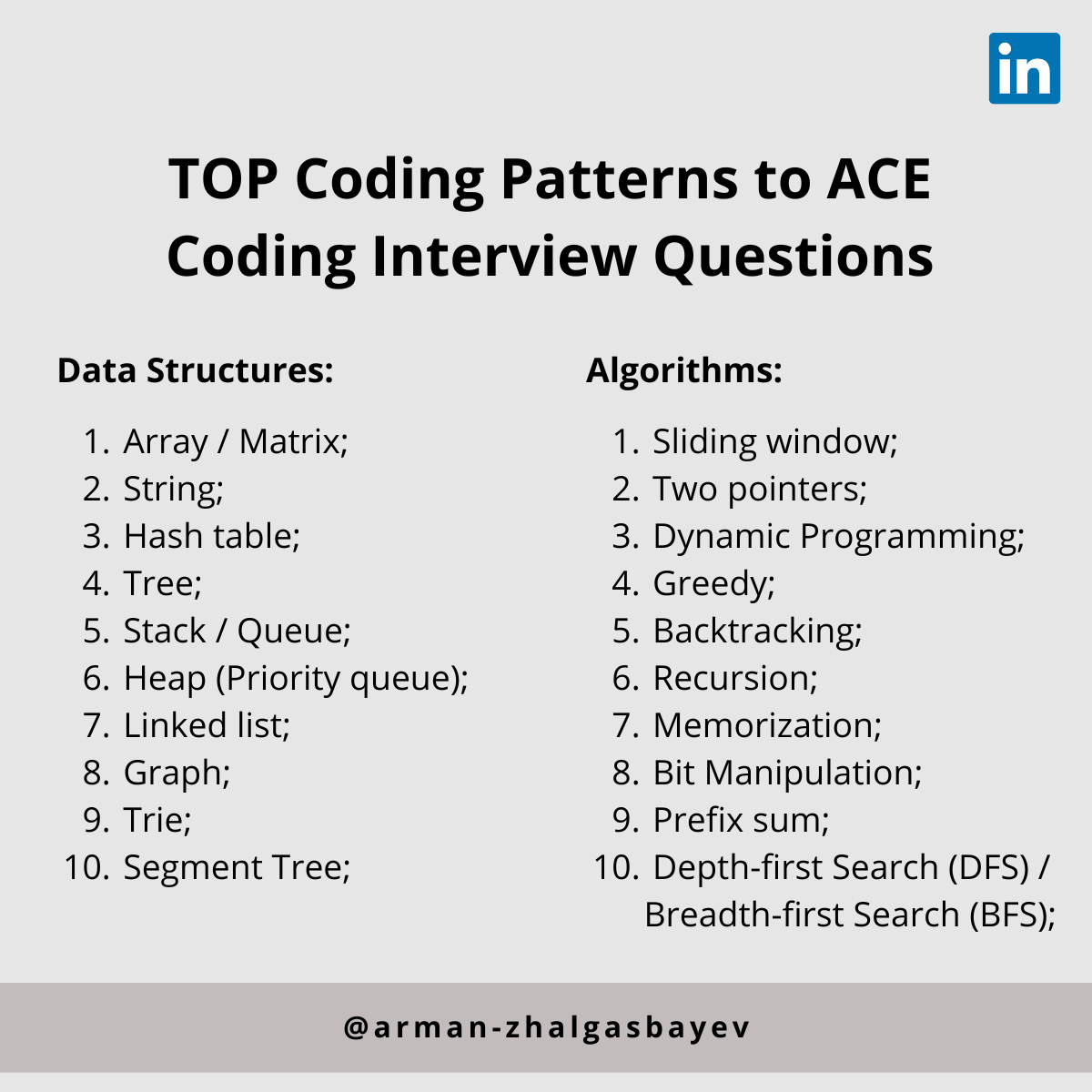
, Data structures:
- 1️⃣ Array / Matrix - arrays are sets of elements stored in adjacent memory locations. Matrices are two-dimensional arrays.
- 2️⃣ String - Strings are sequences of characters used to represent text.
- 3️⃣ Hash table - Hash tables store key-value pairs, which provides fast search.
- 4️⃣ Tree - Trees are hierarchical data structures with nodes connected by edges.
- Stack / Queue - Stacks follow the LIFO rule (Last when exiting first), and queues follow the FIFO rule (First when exiting first).
- 6️⃣ Heap (priority queue) - Heaps are specialized tree structures that satisfy the heap property.
- Linked List - Linked lists are linear data structures in which elements are stored in nodes, each of which points to the next one.
- 8️⃣ Graph - Graphs consist of nodes connected by edges representing relationships between objects.
- 9. Sorts are tree structures used to store strings and provide efficient search.
- Segment Tree - Segment trees are extended data structures used to respond to range queries.
, Algorithms:
- Sliding window is a method of solving problems related to arrays/lists by saving a subset of elements.
- 2️⃣ Two pointers is a method based on using two pointers to efficiently solve problems related to arrays/lists.
- Dynamic programming (DP) is a method of solving problems by breaking them down into simpler subtasks.
- 4. Greedy algorithms that make optimal choices at each step to find the overall optimal solution.
- 5. Backtracking is a method of gradually solving problems, creating candidates and rejecting them in case of failure.
- 6. Recursion is a method in which a function calls itself to solve smaller instances of the same problem.
- 7. Memorization - storing the results of expensive function calls and reusing them when re-entering the same data.
- 8. Bit manipulation - algorithms that include direct operations with bits for optimization.
- 9️⃣ Prefix sum is a method of manipulating an array to effectively respond to range summation requests.
- Depth-first search (DFS) / breadth-first search (BFS) are traversal methods for examining nodes and edges in a graph.
, Study plans:
- Entry code 75: https://leetcode.com/studyplan/leetcode-75 /
- The 150 best interviews: https://leetcode.com/studyplan/top-interview-150 /
- 75 blind interviews: https://leetcode.com/problem-list/p84sdn5t /
- NeetCode.io The roadmap: https://neetcode.io/roadmap
- Interview School: https://interviews.school /
Online interview practice:
- Trial evaluation by LeetCode: https://leetcode.com/assessment /
- HackerRank Certificates: https://www.hackerrank.com/skills-verification
"Success is not the key to happiness. Happiness is the key to success. If you like what you do, you will succeed." © Albert Schweitzer
#CodingInterview #TechInterviews #Data Structures #Algorithms #LeetCode #HackerRank #Career Development #Software Development
Remember that consistent practice and understanding of these patterns can significantly increase your self-confidence and job performance in interviews.
, Data structures:
- 1️⃣ Array / Matrix - arrays are sets of elements stored in adjacent memory locations. Matrices are two-dimensional arrays.
- 2️⃣ String - Strings are sequences of characters used to represent text.
- 3️⃣ Hash table - Hash tables store key-value pairs, which provides fast search.
- 4️⃣ Tree - Trees are hierarchical data structures with nodes connected by edges.
- Stack / Queue - Stacks follow the LIFO rule (Last when exiting first), and queues follow the FIFO rule (First when exiting first).
- 6️⃣ Heap (priority queue) - Heaps are specialized tree structures that satisfy the heap property.
- Linked List - Linked lists are linear data structures in which elements are stored in nodes, each of which points to the next one.
- 8️⃣ Graph - Graphs consist of nodes connected by edges representing relationships between objects.
- 9. Sorts are tree structures used to store strings and provide efficient search.
- Segment Tree - Segment trees are extended data structures used to respond to range queries.
, Algorithms:
- Sliding window is a method of solving problems related to arrays/lists by saving a subset of elements.
- 2️⃣ Two pointers is a method based on using two pointers to efficiently solve problems related to arrays/lists.
- Dynamic programming (DP) is a method of solving problems by breaking them down into simpler subtasks.
- 4. Greedy algorithms that make optimal choices at each step to find the overall optimal solution.
- 5. Backtracking is a method of gradually solving problems, creating candidates and rejecting them in case of failure.
- 6. Recursion is a method in which a function calls itself to solve smaller instances of the same problem.
- 7. Memorization - storing the results of expensive function calls and reusing them when re-entering the same data.
- 8. Bit manipulation - algorithms that include direct operations with bits for optimization.
- 9️⃣ Prefix sum is a method of manipulating an array to effectively respond to range summation requests.
- Depth-first search (DFS) / breadth-first search (BFS) are traversal methods for examining nodes and edges in a graph.
, Study plans:
- Entry code 75: https://leetcode.com/studyplan/leetcode-75 /
- The 150 best interviews: https://leetcode.com/studyplan/top-interview-150 /
- 75 blind interviews: https://leetcode.com/problem-list/p84sdn5t /
- NeetCode.io The roadmap: https://neetcode.io/roadmap
- Interview School: https://interviews.school /
Online interview practice:
- Trial evaluation by LeetCode: https://leetcode.com/assessment /
- HackerRank Certificates: https://www.hackerrank.com/skills-verification
"Success is not the key to happiness. Happiness is the key to success. If you like what you do, you will succeed." © Albert Schweitzer
#CodingInterview #TechInterviews #Data Structures #Algorithms #LeetCode #HackerRank #Career Development #Software Development
 Share
Share