


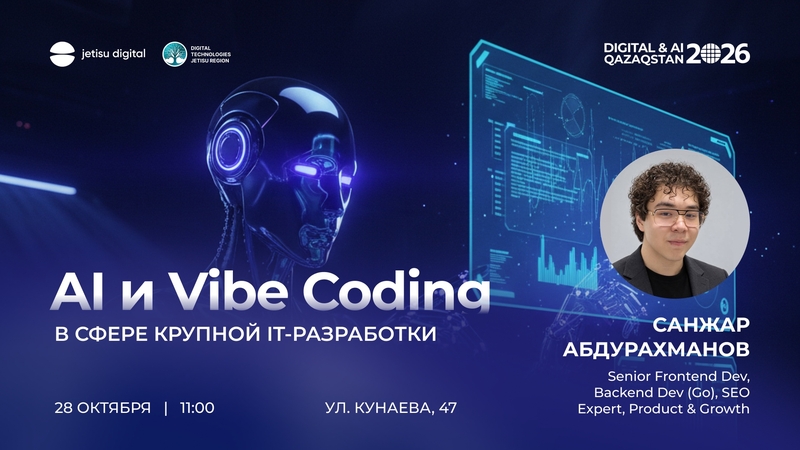
Jetisu Digital | Artificial Intelligence and Vibe Coding in Large-Scale IT Development
IT HUB Jetisu Digital invites senior developers, backend and frontend engineers, product managers, and anyone looking to build effective enterprise-level development using neural networks to a hands-on workshop. Learn how to integrate AI tools into complex architectural processes without sacrificing quality or security.
🎤 Speaker: Sanzhar Abdurakhmanov — Senior Frontend Dev, Backend Dev (Go), SEO Expert, Product & Growth. Expert with 8 years of experience in development, including 6 years of commercial experience in companies.
⠀
🎯 What will happen at the workshop:
⚙️ Optimization: Automating routine code writing, refactoring, and testing tasks using AI assistants at the scale of a large project.
⚡️ Efficiency: Correct prompt formulation and integration of AI into existing development processes, product analytics, and SEO to accelerate time-to-market.
🛠 Practice: Analysis of real Vibe Coding use cases at Frontend and Backend levels, designing a resilient architecture with neural networks.
⠀
📆 Date and time: October 28, 11:00 AM
🌐 Location: 47 Kunaev Street (IT HUB Jetisu Digital)
To attend the event, please download the Astana Hub app in advance and register.































 Share
Share