





The post has been translated automatically. Original language: Russian




"To grow up to be a middle specialist, you need more experience." Is the answer familiar? It seems clear that more work needs to be done, but it is unclear what. What tasks are you already solving at the middle level? Where do you need the help of more experienced colleagues? And is it possible to gain the missing experience on the current project?
The manager has his own side of this task. He sees that the developer is confidently coping with his usual work. Now he needs to understand which more difficult task can be assigned to this person, where support will be needed and on which project he will be able to develop the necessary skills.
In order for the developers and I to have common benchmarks for evaluating skills and planning growth, I started developing competence maps for my 1C team. Later, I transferred this approach to mentoring practice at ProMentor. I'll tell you how the map works, how to evaluate the developer's skills using it, and how to turn this assessment into a development plan.
What is a competence map?
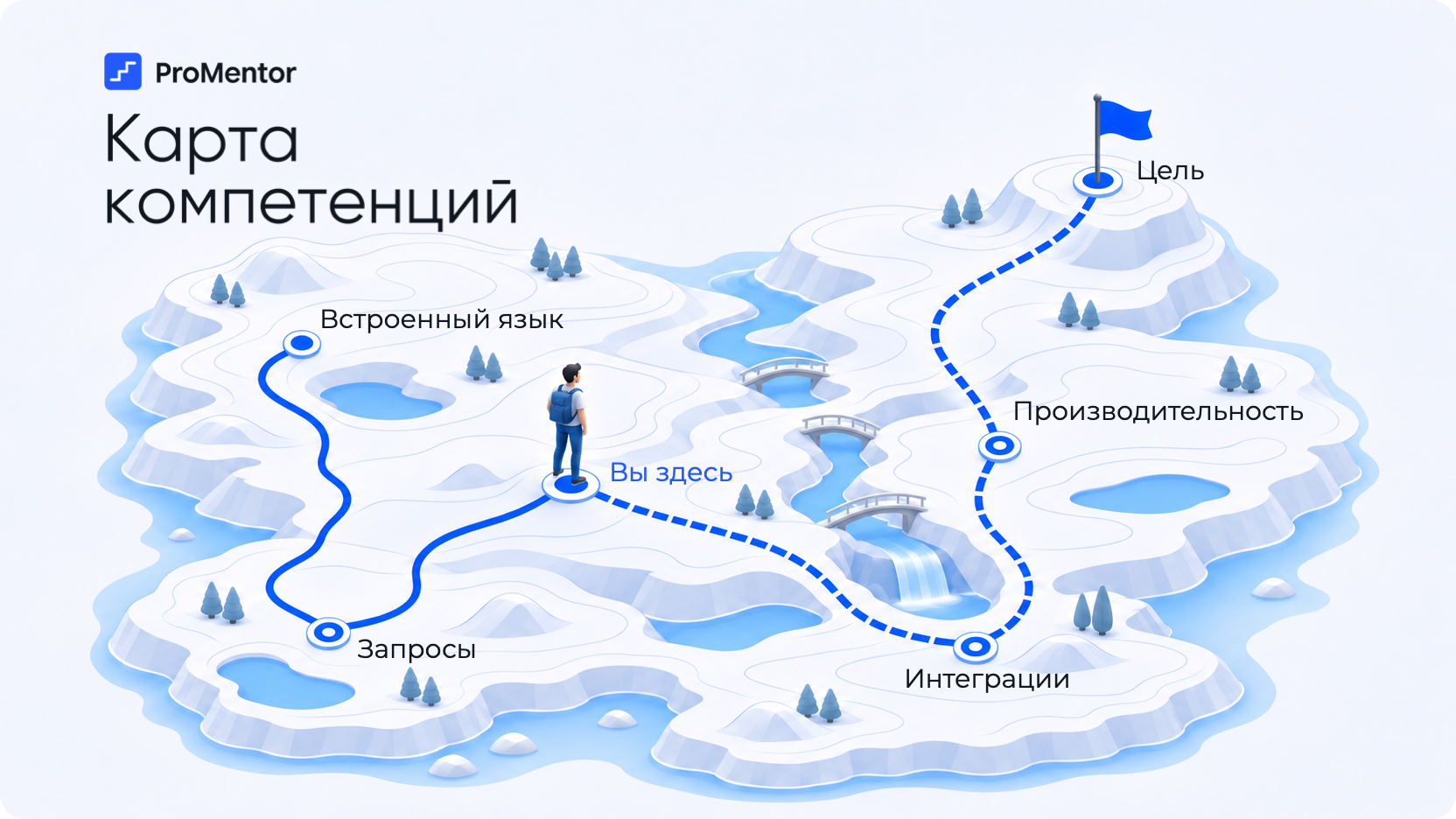
The competence map describes what knowledge and skills a specialist needs at each grade. In 1C development, competencies can be grouped by topic, such as queries, integrations, standard configurations, and development standards. For each topic, we describe what a developer should know at the junior, middle, or senior level, and what tasks they should be able to solve on their own.
The map is also called the competence matrix. But the parallel with the map is closer to me: you can see the whole landscape, your current point, and you can plot a route to the goal with intermediate stops.
How do I rate skills on the map?
In the team, the map helps to plan the growth of a developer in stages — first from an intern to a junior, then to an independent middle and then to a senior.
First, we determine what the intern needs to master in order to get involved in the work and give theory and practical tasks that will move him towards the goal.
When he has a theoretical base and practical experience, we check the map again and select tasks for development to the next grade.
And so we act progressively until the specialist gets back on his feet.
In mentoring, the starting point may be a request from the developer himself. For example, he wants to understand if he is ready to move to the next grade or what skills he lacks to work on a new project.
If the developer already has practical experience, I first clarify his goal and ask him to tell me about the tasks that he solved. With this in mind, I choose which topics to explore in more detail.
The analysis itself is similar to a technical interview.
- I'm asking you which topics the developer is familiar with. I walk along the map and ask him what he knows about each topic and whether he has ever had to solve such problems in practice. If the topic is unfamiliar, I mark it and move on to the next one.
- I analyze familiar topics in more detail. I start with basic questions and ask for examples from my work. If the developer answers confidently, I move on to more complex questions. If he finds it difficult already at the basic level, I note exactly what the difficulties are. This way, for each topic, it becomes clear what a person knows in theory and what tasks they are already solving on their own.
- We set priorities together. When the analysis is completed, we compare the results with the developer's goal. We decide which gaps are important to close first, and which topics can be postponed. On this basis, we draw up a development plan.
In my experience, this analysis usually takes about an hour. It sometimes takes up to two hours to evaluate the skills of a senior specialist.
If a person starts from scratch, I use the map as a checklist: I choose basic topics to start with, and as we learn, we note what they have already mastered.
What does the card give to the specialist himself
As a result of the analysis, the developer sees which tasks he is already confidently solving, which he can undertake with the support of a colleague, and which ones he should prepare for. This makes it easier to figure out what to tighten up first. The card also helps in the interview: the developer can tell you more about his experience, give specific examples and explain which part of the work he was responsible for.
Let's say a developer confidently solves system integration tasks, but has hardly worked with typical configurations. Integration experience is his strong point, which he can rely on when choosing a project. If a developer wants to master typical configurations, a small refinement may be the task of growth. First, he figures out how the necessary mechanism works, then performs the task and discusses his decision with a colleague for a review. The results show what he did on his own and what else is worth working on.
What the card gives to the team leader
Employee development. The map helps to discuss the transition between grades in detail. The supervisor and the developer can agree on which tasks the specialist needs to learn how to solve independently and on which project he will be able to get such an internship.
Hiring. With the help of the map, the team determines in advance which skills the candidate needs from the first day, and which he will be able to master in the process. According to these criteria, you can create questions for a technical interview, and after that discuss what skills the candidate has demonstrated.
Selection of specialists for projects. The map helps you compare the project requirements with the team's experience. For example, you can assign complex integration to a developer who has already solved similar problems. A colleague who wants to grow in this direction can be given a separate piece of work and agree on who will check his decision.
What does the competence map give to the developer and the team in the end?
The competence map helps to agree on what is considered professional growth in the team. When it is described for each grade what tasks a person should be able to solve, the conversation about development becomes substantive.
The developer can evaluate his experience and understand what he lacks so far.
The manager sees what skills the team already has, which ones need to be developed, and on which projects employees will be able to get the right practice.
Therefore, the same card can be used for hiring, job allocation, and promotion discussions.
If a developer wants to grow to the next grade, he and the supervisor have common criteria by which they can discuss his level and agree on a development plan.
And then the progress can be seen in the work itself — by what tasks a person is already coping with on their own.
Do you use competence maps in your teams? If you have a different approach, tell us what helps you plan for the development of specialists.
«Чтобы вырасти до middle-специалиста, тебе нужно больше опыта». Знакомый ответ? Вроде бы понятно, что надо ещё поработать, но непонятно над чем. Какие задачи вы уже решаете на уровне middle? Где пока нужна помощь более опытных коллег? И можно ли получить недостающий опыт на текущем проекте?
У руководителя своя сторона этой задачи. Он видит, что разработчик уверенно справляется с привычной работой. Теперь ему нужно понять, какую задачу посложнее можно поручить этому человеку, где понадобится поддержка и на каком проекте он сможет развить нужные навыки.
Чтобы у нас с разработчиками были общие ориентиры для оценки навыков и планирования роста, я начал разрабатывать карты компетенций для своей команды 1С. Позже я перенёс этот подход в менторскую практику в ProMentor. Расскажу, как устроена карта, как по ней оценить навыки разработчика и как превратить эту оценку в план развития.
Что такое карта компетенций
Карта компетенций описывает, какие знания и навыки нужны специалисту на каждом грейде. В 1С-разработке компетенции можно сгруппировать по темам — например, выделить запросы, интеграции, типовые конфигурации и стандарты разработки. Для каждой темы мы описываем, что должен знать разработчик на уровне junior, middle или senior, и какие задачи он должен уметь решать самостоятельно.
Карту ещё называют матрицей компетенций. Но мне ближе параллель с картой: видишь весь ландшафт, свою текущую точку и можешь проложить маршрут к цели с промежуточными остановками.
Как я оцениваю навыки по карте
В команде карта помогает планировать рост разработчика поэтапно — сначала от стажёра до junior, затем до самостоятельного middle и дальше до senior.
Сначала мы определяем, что стажёру нужно освоить, чтобы включиться в работу и даем теорию и практические задачи, которые его продвигают к цели.
Когда у него появляется теоретическая база и практический опыт, снова сверяемся с картой и выбираем задачи для развития до следующего грейда.
И так действуем поступательно, пока специалист крепко не встанет на ноги.
В менторстве отправной точкой может быть запрос самого разработчика. Например, он хочет понять, готов ли к переходу на следующий грейд или каких навыков ему не хватает для работы на новом проекте.
Если у разработчика уже есть практический опыт, я сначала уточняю его цель и прошу рассказать о задачах, которые он решал. С учётом этого выбираю, какие темы разобрать подробнее.
Сам разбор похож на техническое интервью.
- Уточняю, с какими темами разработчик знаком. Иду по карте и спрашиваю, что он знает по каждой теме и приходилось ли ему решать такие задачи на практике. Если тема незнакома, отмечаю это и перехожу к следующей.
- Разбираю знакомые темы подробнее. Начинаю с базовых вопросов и прошу привести примеры из работы. Если разработчик отвечает уверенно, перехожу к более сложным вопросам. Если он затрудняется уже на базовых, отмечаю, с чем именно возникли трудности. Так по каждой теме становится понятно, что человек знает в теории и какие задачи уже решает самостоятельно.
- Вместе определяем приоритеты. Когда разбор закончен, мы сверяем результаты с целью разработчика. Решаем, какие пробелы важно закрыть в первую очередь, а какие темы можно отложить. На этой основе составляем план развития.
По моему опыту, такой разбор обычно занимает около часа. На оценку навыков специалиста старшего грейда иногда уходит до двух часов.
Если человек начинает с нуля, я использую карту как чек-лист: выбираю базовые темы для старта, а по мере обучения мы отмечаем, что он уже освоил.
Что карта даёт самому специалисту
В результате разбора разработчик видит, какие задачи он уже решает уверенно, за какие может взяться с поддержкой коллеги, а к каким пока стоит подготовиться. Так проще понять, что подтянуть в первую очередь. Карта помогает и на собеседовании: разработчик может точнее рассказать о своём опыте, привести конкретные примеры и объяснить, за какую часть работы отвечал.
Допустим, разработчик уверенно решает задачи по интеграции систем, но почти не работал с типовыми конфигурациями. Опыт интеграций — его сильная сторона, на которую можно опереться при выборе проекта. Если разработчик хочет освоить типовые конфигурации, задачей на вырост может стать небольшая доработка. Сначала он разбирается, как устроен нужный механизм, затем выполняет задачу и обсуждает своё решение с коллегой на ревью. По итогам видно, с чем он справился сам и что ещё стоит отработать.
Что карта даёт руководителю команды
Развитие сотрудников. Карта помогает предметно обсуждать переход между грейдами. Руководитель и разработчик могут договориться, какие задачи специалисту нужно научиться решать самостоятельно и на каком проекте он сможет получить такую практику.
Найм. С помощью карты команда заранее определяет, какие навыки нужны кандидату с первого дня, а какие он сможет освоить в процессе работы. По этим критериям можно составить вопросы для технического интервью, а после него обсудить, какие навыки кандидат продемонстрировал.
Подбор специалистов на проекты. Карта помогает сопоставить требования проекта с опытом команды. Например, сложную интеграцию можно поручить разработчику, который уже решал похожие задачи. Коллеге, который хочет вырасти в этом направлении, можно дать отдельную часть работы и договориться, кто проверит его решение.
Что в итоге даёт карта компетенций разработчику и команде
Карта компетенций помогает договориться о том, что в команде считается профессиональным ростом. Когда для каждого грейда описано, какие задачи человек должен уметь решать, разговор о развитии становится предметным.
Разработчик может оценить свой опыт и понять, чего ему пока не хватает.
Руководитель видит, какие навыки уже есть в команде, какие нужно развивать и на каких проектах сотрудники смогут получить нужную практику.
Поэтому одной и той же картой можно пользоваться при найме, распределении работы и обсуждении повышения.
Если разработчик хочет вырасти до следующего грейда, у него и у руководителя есть общие критерии, по которым они могут обсудить его уровень и договориться о плане развития.
А дальше прогресс можно увидеть в самой работе — по тому, с какими задачами человек уже справляется самостоятельно.
Вы используете карты компетенций в своих командах? Если у вас другой подход, расскажите, что помогает вам планировать развитие специалистов.







 Privacy Policy


Comments 0
Newest Popular